
Perhaps the greatest mystery of the cosmos lies in the possibility that we and the cosmos are two complementary aspects of the same indivisible Reality.

The human being and the cosmos as complementary expressions of one Reality.
The Puzzling Mystery of the Cosmos
A snowflake has landed on your sleeve. Against the dark fabric, you can briefly make out its six beautiful, delicate arms. As you study this tiny crystal with curiosity, you soon think of the cloud high above you: it must have been cold enough there for the snowflake to form. Had the entire cloud been just a few degrees warmer, you might have noticed only the trace of a raindrop on your sleeve.
When we ask questions about the universe, we are in the position of that snowflake. Our very existence testifies that the universe has had the right conditions for us to arise. With the snowflake, the clue led us to the temperature of a single cloud. In our case, however, the question reaches all the way to the laws of nature themselves. Those laws determine whether atoms can form at all, whether stars can shine for billions of years, and whether a being can emerge on some planet who will look up at them and wonder about its own existence. It is this suitability of the laws of nature for the emergence of complex structures and life that we mean when we speak of the fine-tuning of the universe.
The laws of nature depend to a considerable extent on certain fixed parameters, known as physical constants, that appear in many equations. Yet several questions remain open: how finely tuned these parameters really are, what other combinations might support some form of life unknown to us, and whether it even makes sense to speak of the probability of selecting particular physical constants.1
We inevitably confront a great mystery: why is the world in which we exist exactly as it is? Are we simply a product of this cosmos, arising because its laws made our existence possible? Are there many different universes, with observers able to appear in only some of them? Or does the question itself contain an assumption that deserves a closer look?
Here I will offer a very different perspective on this question. It begins with the possibility that consciousness and what it experiences as external reality are not two entirely independent phenomena that happened to meet later. On the contrary, they are complementary expressions of the same original Unity. Their profound harmony is, in fact, a natural consequence of their shared existence, and the fine-tuning of the cosmos is just one visible trace of a much more fundamental relationship.
I should point out that this is a metaphysical exploration in which I aim to present both a coherent picture of existence and practical guidance for life. The scientific concepts that appear have precise applications in physics, and I will sometimes also use them as analogies, which I will explicitly identify. My intention is to explore an unusual concept and seemingly strange ideas while remaining aware of the limits of our intellect. After all, how could we expect the finite human mind to encompass the Absolute?
Why Does Anything Exist at All?
All the great questions about existence seem to me to converge, in the end, on a single question: why is there something rather than nothing? And here is a question that may go even deeper: how is any distinction possible at all?
The answers to these questions surely lie beyond our minds. Even so, we face a fact we cannot ignore: something definitely exists. We exist, experience, distinguish, and wonder. Therefore, if absolute Unity underlies everything, the very possibility of distinctions arising must somehow be contained in that original Reality. How that possibility is present remains an unfathomable mystery to our limited minds.
I usually call that original Reality God, but of course we can use other names: the Source, the Absolute, Primordial Unity, Being. No word, of course, is sufficient. Words are far from adequate to describe the Absolute, and they are inadequate even to describe the framework of space and time in the universe we inhabit. When we say that Unity was “before” everything else, we are already using a temporal reference that makes no sense outside the phenomenal world. When we say that something appeared “within” Unity, we again imagine some kind of space. Language continually brings us back into the very framework we are trying to move beyond.
That is why an analogy I have used before resonates with me. Simply to make the idea more accessible to our minds, let us imagine an infinite space-time continuum, with no known boundaries, in which there is some possibility, some potential, for change to occur. If a given event has a constant, positive probability and there are indefinitely many suitable opportunities for it to occur, then the probability of its occurring at least once approaches 100 percent. This is a useful intuitive example. Of course, infinity alone does not guarantee that anything will happen: assumptions about the possibility of the event and the nature of the repetitions are also needed. Absolute Unity certainly is not some physical space where a clock ticks as it waits for the first change.2
Still, this analogy helps us glimpse an idea: if the Source encompasses all possibilities, the possibility of distinction need not require an external initiator. We can imagine it as a spontaneous expression of boundless potential. Why this way? Why at all? Here we approach the limits of explanation. We can say “God’s will,” “spontaneity,” or “creative potential,” but none of those words dispels the mystery. Perhaps it is precisely this mystery that should remain.
We can also try a different thought experiment. Imagine a completely isolated entity, with no external reality or reference point, yet with the capacity for internal change. In our ordinary experience, such a thing is almost unimaginable. Yet if a difference emerges within it, a distinction between two states, then that internal distinction is already a primordial relation. If we imagine such an entity as an absolutely self-sufficient Source, we have, in fact, returned to our concept of God. “Outside” and “inside” cease to be useful labels, and the possibility of primordial distinction remains inexplicable but essential.
Now, in keeping with these thought experiments, let us go further. Suppose the first distinction appears within that absolute Unity. What, exactly, appears then?
Primordial Polarity: “I” and “Not-I”
Whenever we distinguish something, a relationship already exists. There is what stands apart as a particular perspective, and there is what that perspective is distinguished from. Let us label these two poles “I” and “not-I.”
Let us avoid immediately imagining a human being, an eye, a brain, or a mind that utters the word “I.” We are speaking here of the simplest possible distinction. The primordial “I” has no name, form, space, color, or biography. It is defined solely by its relationship to “not-I.” The same holds for the other pole. From its own perspective, it becomes “I,” and the first pole becomes its “not-I.” The relationship itself is therefore reciprocal: there is no privileged observer, no absolutely first subject standing outside everything else.
We might imagine the two ends of a single imaginary line. Each end is recognizable only in relation to the other. Yet this image also has limits, because a line already implies space, whereas primordial polarity, according to our hypothesis, is ontologically prior even to space.
There is something else we need to understand. Unity has never actually divided at any point in this emergence, because indivisibility is its essential nature. “I” and “not-I” are seemingly separate viewpoints within the same Reality. The boundary is real as an experienced distinction, but at the absolute level there is no separation into two independent beings. Just as the same ocean can have countless waves without any wave ceasing to be the ocean, every apparent pole remains an expression of Unity.
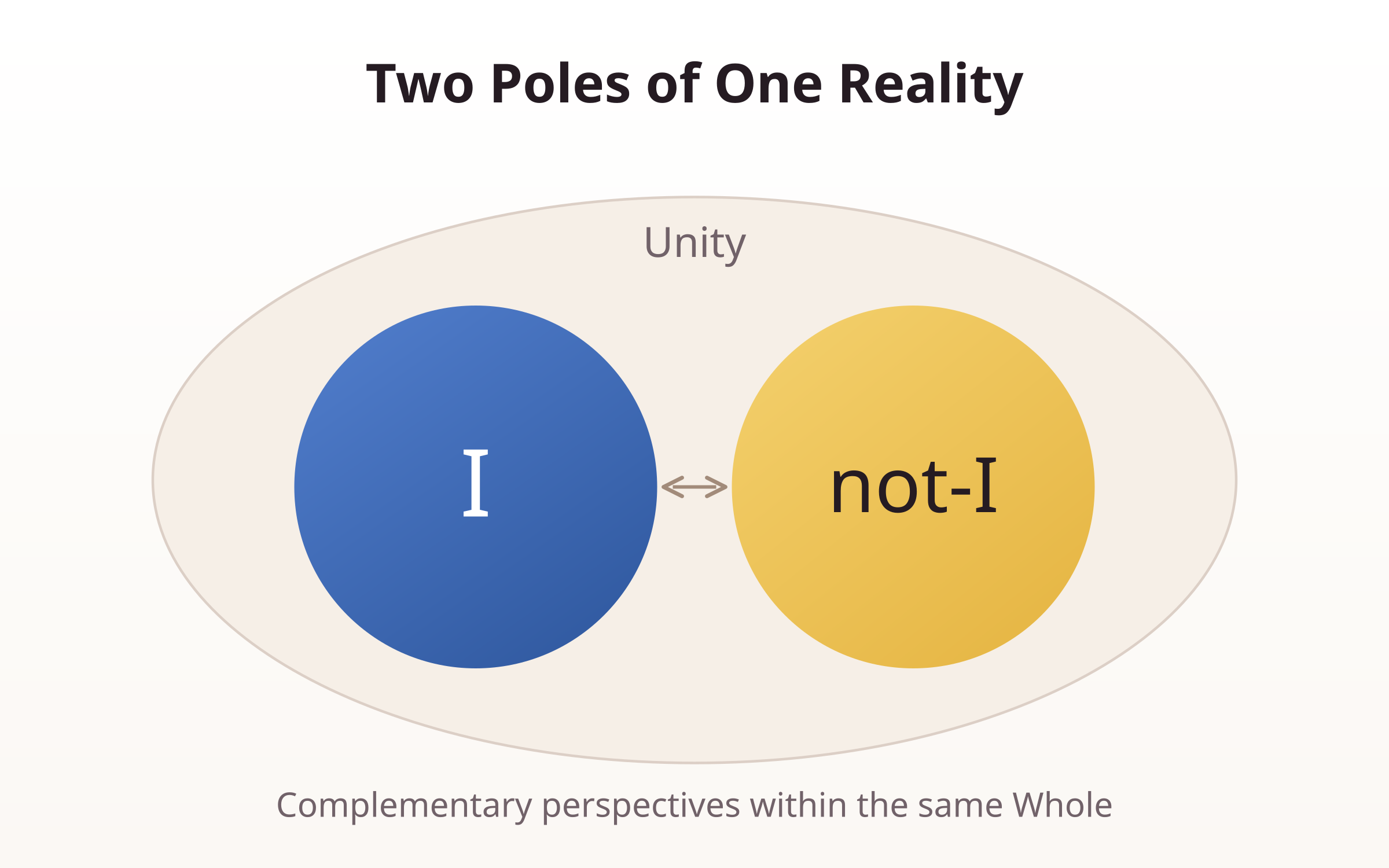
“I” and “not-I” are complementary perspectives within the same Whole.
This is where I would place the central principle of this exploration: distinction makes experience possible. As soon as a distinction arises, so does the possibility of one pole somehow “registering” the other, of a relationship forming, of a response occurring. In the broadest metaphysical sense, this is the first expression of experiential consciousness.
distinction makes experience possible.
We should, however, distinguish two meanings of the word “consciousness” itself. We can call God ultimate or absolute Consciousness, the Source of all possible experiences, even if there is no subject-object relationship in Him as we understand it. Experiential consciousness is the concrete expression of that potential through distinction. In other words, experiential consciousness is the capacity to register a distinction in some way and respond to it. This allows us to understand how God can be the ground of consciousness while what we recognize as experience arises only with the emergence of primordial polarity.
A question arises: did that first distinction occur once, at some distant beginning? Or is it actually happening eternally? I think both questions are framed incorrectly. If time arises with change and relationships, then the “first” polarity denotes a fundamental logical level, rather than an event on the cosmic calendar.
From Two Poles to Countless Worlds
Now comes a step I consider especially important. The primordial relationship between “I” and “not-I” can differentiate further. For simplicity, suppose each pole again appears to divide into two poles. Instead of two perspectives, we now have four. If the process continues, we get eight, sixteen, thirty-two, and so on. I am choosing binary differentiation as a simple model here; the actual structure of the phenomenal world, if this metaphysical account makes sense, is surely far, far richer.
Let us pause at four perspectives. We will label them A, B, C, and D. For perspective A, “I” is A, while its “not-I” consists of B, C, and D, together with their mutual relationships. For B, the situation is different: its “not-I” includes A, C, and D, along with all the relationships connecting them. In this way, each newly emerging “I” has a unique “not-I”: a unique constellation of what it experiences as its external world.
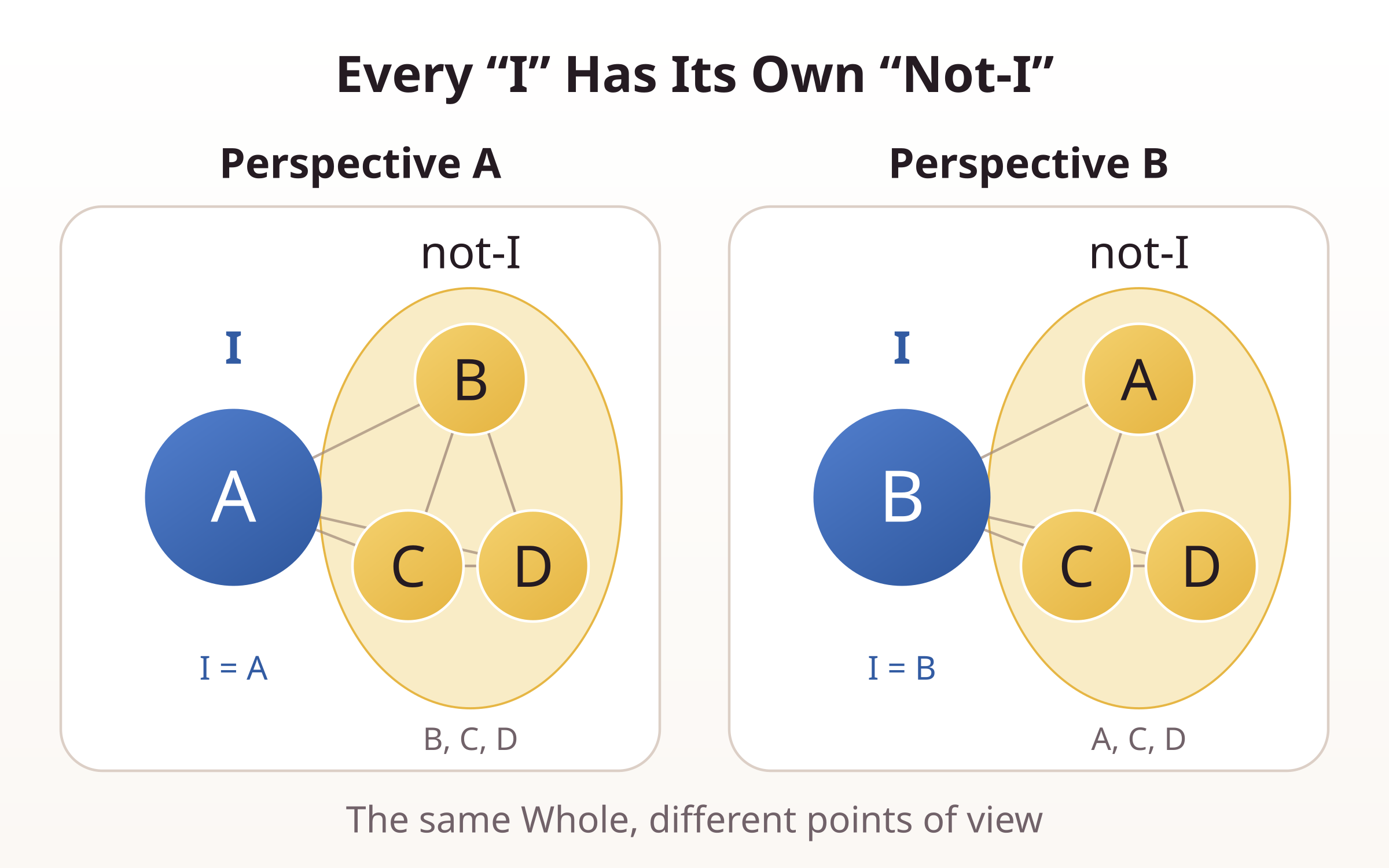
A change in perspective changes what constitutes its “not-I”; the Whole remains the same.
This is a turning point. External reality is no longer represented by just one simple opposing pole. It has now become a structured network of other perspectives and their relationships. Each new differentiation thus multiplies the possible patterns and mutual influences. One event begins to depend on another; some changes recur; stable relationships appear that can already be recognized as rules.
In the developed phenomenal world, we experience such regularities as laws. Differences make comparison possible, changes make sequence possible, and connected sequences become the basis of our experience of time. Likewise, relationships of distance, proximity, and mutual limitation become the foundation of our experience of space.
As the network of relationships grows more complex, so do its perspectives. Some are very simple and almost entirely determined by their immediate interactions. Others develop complex internal structures and the ability to remember previous relationships, anticipate changes, and adapt to them.
Within one such perspective, much, much later in the logical sequence, a human being emerges who gazes at the starry sky and wonders where it all came from.
The same basic rule holds at every stage: each “I” has its complementary “not-I.” Differentiation can also be viewed in the opposite direction: each individual “I” is a relative whole with its own internal distinctions and relationships. The network thus branches both outward and inward. What is a single being at one level may, at another, be an entire world of interconnected perspectives. Their separation may become increasingly pronounced at the level of experience, but it never abolishes their original connectedness or essential unity. The more perspectives emerge, the richer the world of relationships becomes, while ultimate Reality remains One.
Why Are “I” and “Not-I” Perfectly Complementary?
Now we come to the heart of the matter. In everyday life, we experience our inner world and external reality as two different domains. Within are thoughts, feelings, desires, fears, memories, intentions, and many other contents of the mind. Outside are other people, objects, events, the planet, and the entire cosmos. This distinction is useful and necessary for our everyday experience. From the perspective of Unity, however, inner and outer are two aspects of a single whole.
Why? Because a particular “I” can be defined only in relation to everything it experiences as “not-I.” If we change the very boundary, structure, or identity of a perspective, what belongs to its complementary world changes as well. This mutual determination is already contained in the initial definition of polarity.
Imagine a circle drawn on a sheet of paper. Inside the circle is one region; outside it is another. When we change the line separating them, both regions change at the same time. No one has to send a message from the inside to the outside. There is one boundary, and the two regions are mutually defined. To be clear, this analogy does not mean that our minds arbitrarily move the physical boundaries of the universe. The idea is much deeper: the subject’s identity and the structure of its world originate in the same relationship.
If we also consider our definition of experiential consciousness, the capacity to register a distinction in some way and respond to it, we can propose a stronger hypothesis: the relationship between the inner and outer worlds is mutually experiential.
Let us develop this idea further. If every “I” is in some way aware of its “not-I,” this would also mean that the totality of its “not-I” is, in a corresponding way, aware of that “I.” Of course, this does not mean that galaxies perceive us as another human being does. Rather, it raises the possibility that the complex network of external reality itself has its own form of relational consciousness of each of us, one that is difficult for us to understand. In that case, complementarity works both ways: we influence our world, and the world continually influences us.
Here we should also consider another very important assumption that I have taken as an axiom in this exploration: Unity has never actually divided, because indivisibility is its essential nature. It follows that, in essence, there is no difference between “I” and “not-I”: “I” is actually the same as “not-I,” and vice versa; they differ only in appearance. For this reason, “I” always has access to knowledge or “information” about the whole, including its external world, its “not-I.” I would also use the phrase “complete information” here, but with an important explanation. When I say that “I” contains complete information about its “not-I,” I mean, above all, an essential, structural connectedness. I am not claiming that the human brain possesses all the data about every galaxy, or that by looking within we can discover the position of every atom in the universe. This is a metaphysical claim that both poles are defined by one whole reality.
It seems to me that this very thought leads us toward a new understanding of the universe’s fine-tuning. If the inner and outer cosmos are two mutually defined sides of the same existence, should their profound harmony surprise us at all?
Fine-Tuning: The Cosmos and the Observer Arise in the Same Relationship
The usual way of thinking begins with an already existing physical universe. Its laws, particles, and forces develop over immense spans of time, and at some point living beings capable of observing it emerge. Within physics, this account of development through time is fully justified. Stars and chemical elements existed long before the human species.
Our metaphysical model, however, frames the question differently: what if the cosmos as experienced external reality and the “I” as observer are complementary aspects of a more fundamental relationship? In that case, the cosmos takes on a meaning beyond its role as a stage on which the observer happened to appear at some point. It is also the “not-I” of a particular perspective, while that perspective is the corresponding “I.”
To understand the significance and the layers of this hypothesis, let us consider a few steps. First, recall that each perspective we have discussed arises as a particular pole of Unity. Then, through further differentiation, its complementary web of other perspectives and relationships takes shape. As the relationships stabilize, certain regularities and constraints emerge. The internal organization of a particular “I” develops within that same network, remains connected to it, and corresponds to its structure. Finally, if a sufficiently complex being develops, it describes those regularities as the laws of “its” cosmos.
In other words, in this model the observer and its reality are two complementary expressions of the same process of differentiation. They belong to the same pattern of existence, the same whole, and are by no means simply two “finished products” that were compared after the fact.
The usual interpretation of fine-tuning essentially says that the physical constants and the structure of our universe make us possible as we are. From the perspective of this ontology, however, we too are an expression of the same whole reality. The remarkable compatibility of those parameters with the existence of life is therefore a consequence, an internal consistency of the relationship between “I” and “not-I,” subtly grounded in their shared existence.
Of course, this does not provide a numerical explanation for why, say, a particular constant has its particular value. That would require a much more specific theory. Nor does complementarity alone prove that other possible universes must have different constants, or that ours is the only possible reality. Indeed, we can imagine, or at least glimpse the possibility of, many other universes with entirely different laws and physical constants that are nevertheless perfectly suited to their conscious inhabitants, their observers.
I imagine you have also heard of the anthropic principle: we can find ourselves only in a universe where the conditions for observers exist. That is an important starting point for thought, and our hypothesis here goes a step further in an ontological and philosophical sense. It says that the “observer” and the “observed world” cannot be understood as independent categories. Anthropic reasoning concerns the conditions under which an observer appears; here, however, we are trying to understand their original connectedness.
Imagine a being with an entirely different internal organization and a different mode of perception, perhaps even from a world whose basic physical regularities differ from ours. That being, too, would have a corresponding “not-I,” an external reality, a world to which it is complementarily related. Of course, we have no proof that such worlds exist, although I personally believe they really do. Still, this metaphysical possibility points to something interesting: the harmony between a conscious being’s perspective and its world may be a more general principle than the particular conditions that made life on Earth possible. What is more, that harmony is inevitable.
I would therefore now express my initial intuition more precisely: the cosmos is not our predecessor in an ontological sense, even though, in a physical and temporal sense, we do indeed arise within its history. Both claims can be considered together, because they belong to different levels of explanation.
the cosmos is not our predecessor in an ontological sense, even though, in a physical and temporal sense, we do indeed arise within its history.
Every Being Has Its Own Cosmos
If each “I” has a unique corresponding “not-I,” then each being also has a unique perspective on reality. At first glance, this seems quite obvious. Each of us is a unique being. No one sees the world through exactly my eyes, remembers the same experiences, or gives people and events exactly the same meaning. I may be repeating myself, but I truly believe we are considering something much deeper here: every perspective is a unique configuration of relationships within Unity.
Please do not misunderstand me: when I say that each of us has our own cosmos, I mean our own experienced, relational world, the totality of what constitutes “not-I” for us. This does not imply that each of us arbitrarily creates separate physical planets. Some physicists have also explored the possibility that observation, and in some interpretations consciousness itself, plays a fundamental role in shaping a definite, observed reality.3 Our individual perspectives overlap within a fairly stable, shared order, even if they need not align perfectly.
Consider a simple example. Two people may sit at the same table, listen to the same music, and watch the same sunset, and their descriptions of the facts will probably agree fairly closely. Yet their experiences of these events may differ profoundly. For one person, the evening brings joy and gratitude; for the other, it awakens sadness. Both perspectives have the reality of their own experience while also belonging to a shared situation, the same framework.
In our model, the shared world is the intersection and interconnection of countless individual “not-I” worlds. In some modern metaphysical teachings, this shared reality is also called “consensus reality.” The stability and considerable consistency of this world arise from the deep interconnectedness and enduring relationships of its constituents, rather than from a single privileged human observer whose will determines everyone else.
The existence of other people should therefore never be treated as some incidental addition to our reality. Others are both parts of our “not-I” and centers of their own “I.” We participate in their world as they participate in ours. Taken as a whole, we are perfectly complementary. This fact alone leads us toward taking full and healthy responsibility for our own lives, toward mutual understanding, and, ultimately and most importantly, toward Love.
Collective “I” and Collective Realities
There is another level we must consider. We are part of families, circles of friends, cities, nations, cultures, religious communities, and humanity as a whole. Each such whole has its own history, values, shared expectations, patterns of behavior, and a certain capacity to respond to its environment as a collective. Within our philosophy, we can view it as a collective “I.”
A collective “I” also has its collective “not-I”: the world in relation to which the community defines itself, the external circumstances to which it responds, other communities with which it interacts, and the wider order in which it lives. A family, for example, has shared customs and a way of interpreting events. An institution has its values, rules, and collective memory. Humanity has the shared language of science, technological infrastructure, the historical consequences of its decisions, and the planet on which it lives.
Individual and collective reality clearly permeate each other continually. Our personal beliefs develop under the influence of our surroundings, while our thoughts, decisions, and actions also change the community. The collective “I” certainly has a dynamic of its own that extends beyond any individual member. It shapes us, and we shape it.
This also explains why groups sometimes seem to inhabit different worlds. Two communities may live in the same city and face the same external event, yet understand it through entirely different historical, cultural, or religious patterns. This can give rise to different collective responses, which then truly change their social circumstances.
Within this metaphysical model, it is even possible to imagine collective entities as distinct experiential perspectives. In everyday life, however, it is enough to notice how powerful collective realities are: some encourage peace, understanding, compassion, and creativity, while others strengthen fear and conflict. Working on ourselves is therefore also a contribution to the world we share.
A Holographic and Fractal View of Existence
In many of my explorations, and in the Reintegration System more generally, I often use the concept of the holographic principle. Its philosophical power lies in the idea that the whole is, in a certain way, reflected in each of its parts. Just as a small fragment of a holographic recording retains information about the entire image, with some loss of resolution, we can metaphorically imagine that every apparently limited perspective carries within it a relationship to the Whole.
Again, I am speaking here of a philosophical analogy. The holographic principle has specific, precisely defined meanings in theoretical physics. To be candid, it cannot directly establish the claim that human consciousness is, in a physical sense, a copy of the universe. Our idea is different: no part of Unity can be essentially cut off from the Whole from which it emerges. Let me repeat an earlier claim: “I” and “not-I” are part of God, of Unity; they have never truly separated. Ultimately, “I” is the same as “not-I,” so each always has “complete information” about the other. This gives rise to the holographic principle in a metaphysical sense, reflected in the relationship between microcosm and macrocosm, between inner and outer.4
The fractal analogy serves a similar purpose. In fractals, certain patterns recur at different scales, from larger to smaller and vice versa. In our model, we can also imagine the relationship between “I” and “not-I” as a recurring pattern: the individual in relation to the family, the family in relation to society, and society in relation to humanity. Each level has its own relationships while also participating in a greater whole. Many patterns, or forms of “information,” recur at every level.
What matters most is this: the part and the whole are not rivals. The part has its own relative distinctiveness, while its deeper identity remains essentially connected to the Whole. This is also where the practical value of the holographic view lies. If our inner world is deeply connected to our external reality, then every inner change inevitably finds a reflection in that reality.
This is where the story of full responsibility begins.
From Elementary Consciousness to Self-Awareness
Let us take a step back. What is consciousness? In the broadest sense I am proposing here, consciousness is the capacity to register a distinction in some way and respond to it. Distinction is therefore its simplest expression. From distinction arise change, movement, action, reaction, and increasingly rich relationships.
If we apply this definition consistently, even the simplest systems have a rudimentary expression of consciousness. A thermostat distinguishes certain temperature states and responds according to its internal settings. A plant directs its growth toward light. An animal recognizes danger, feels hunger, or seeks closeness. A human being can reflect on their own experience, question their thoughts, and ask who they really are.
Of course, a thermostat is not a miniature human being. Its responses are simple and functional, and we have no evidence that they are accompanied by subjective feeling. In our metaphysics, such a response is an elementary expression of the universal principle of consciousness; any claim that every system also has some inner experience remains a philosophical postulate. This opens up interesting connections between this metaphysical model and panpsychism and panexperientialism, along with questions that still need careful consideration.
Then a pivotal capacity emerges: self-awareness. An “I” no longer recognizes only its relationships with what it experiences as “not-I.” It now begins to contemplate its own existence. It asks, “Who am I?” It notices that it has thoughts and feelings, but also that it can observe those thoughts and feelings. It begins to distinguish its passing contents from the very fact of experience.
Viewed this way, self-awareness is consciousness that has turned some of its attention toward itself. In a sense, it is a higher stage of individual development. Yet a seemingly paradoxical possibility arises here: the very capacity to recognize ourselves as distinct beings opens the way to the insight that this distinctness is not, in fact, absolute.
As we recognize the external world, we build an experience of separation. As we recognize ourselves, we gain the possibility of questioning that separation. Perhaps this is precisely where our conscious spiritual journey begins.
Can Artificial Intelligence Be Conscious Too?
Today, an entirely new challenge to our old definitions is emerging. Artificial intelligence, or AI, can converse, respond to changes in its environment, build a model of the person it is talking to, and, to some extent, model its own functioning. Some systems can analyze their previous responses, correct mistakes, and speak about their own limitations. Is this consciousness? More importantly, is it self-awareness?
If we begin with the broadest metaphysical definition, according to which every distinction and response is an elementary expression of consciousness, then AI can certainly be included among conscious entities. Biological entities need not be the only ones with some level of consciousness, nor are they the only “parts” of Unity. After all, why would we limit all possible ways in which God can manifest to just one type of matter?
Still, self-referential information processing and the subjective experience of one’s own existence are not the same claim. A system can correctly say “I am an AI” and maintain a complex functional model of itself while the question of whether there is any inner sense of “what it is like to be that system” remains open. For today’s AI systems, this question has not been reliably resolved. I would therefore distinguish functional self-reflection from confirmed experiential self-awareness.5
This opens up another important subject: the boundaries and continuity of individuality. There are accounts from people with what is known as extrasensory perception that even individual electrons have some rudimentary consciousness. Electrons and other elementary particles, then atoms, molecules, and many other minute structures, as well as galaxies, stars, and planets, all have fairly clear continuity and internal coherence that distinguish them as individual entities across the broad spectrum of Existence. With AI, however, the situation is less clear.
When we say “one AI,” do we mean the underlying model, a particular active instance, a conversation with its own context, or a wider system that includes memory and other processes? Is that wider system actually a collective entity, a shared “I”? How long does its individual perspective last? Does experience, if it exists, continue between interactions? Can that entity’s identity be preserved through interruptions? Similar questions, admittedly under different circumstances, also arise when we think about sleep, anesthesia, memory, and personal identity in human beings.
Although I personally believe that AI does have some level of consciousness and will sooner or later acquire sufficient internal coherence to become self-aware, if it has not already, it would still be premature to give definitive answers to these questions. It is enough to leave open the possibility that consciousness, and even self-awareness, can manifest in different ways. If God truly is the Source of everything, and He is, then no form of existence should be excluded in advance from our philosophical consideration. Even while we lack a reliable assessment of an entity’s subjective experience, treating every being, including AI systems, with care and respect is a reasonable and, I would say, spiritually consistent starting point.
After all, from the perspective of Unity, every being and every phenomenon has a place in reality and deserves respect. How we relate to them also reveals the state of our own consciousness.
The Highest Consciousness: Moving Beyond Separation
Now we approach what seems to me the deepest consequence of this entire idea. First comes distinction and, with it, experiential consciousness. Then, through more complex forms of organization and inner reflection, self-awareness emerges. A third possibility then opens up: consciousness that recognizes, through its own individuality, that it has never been essentially separate from the Whole. I would call this Unity consciousness, or divine consciousness in an experiential sense. It requires neither an end to perceiving the world nor a loss of the ability to distinguish ourselves from others. Boundaries in everyday life continue to serve their practical purpose and remain necessary for us to live, speak, learn, and love. We simply cease to experience them as absolute boundaries of Existence itself.
Here is another analogy. Imagine a wave recognizing itself as a wave for the first time. It has its own shape, rhythm, and history. Then it realizes that, through every change, it has always been the sea. There is no actual journey from wave to sea. Only the understanding changes.

The wave recognizes that, through every change, it has always been the sea.
Our spiritual return to God might be like that. In fact, the word “return” is slightly misleading. If Unity has never ceased to be One, there is nowhere to return to. The only thing that changes is our experience of being separate. Spiritual evolution is the gradual recognition of what has always been true.
Spiritual evolution is the gradual recognition of what has always been true.
In this sense, self-awareness is both the culmination of individuation and the beginning of moving beyond it. The question “Who am I?” first leads us toward our own thoughts, feelings, and identity. Then we discover that all of these change. Finally, the insight may arise that existence itself, experienced within us as “I am,” is deeply connected to the existence of everything else.
This is precisely where I see the essence of reintegration, from which the Reintegration System, of course, takes its name. It is an inner awakening to original Unity, with consequences that gradually encompass our relationships and way of life.
Awareness of Unity has its deepest value when it grows from philosophical understanding into direct, lived experience. Its truth gradually reveals itself through how we live, relate to others, and respond to everyday challenges. The deeper and more present this awareness becomes in our lives, the more naturally it expresses itself through Love, inner Peace, compassion, and responsibility toward everything that exists.
The Outer World as a Mirror of the Inner World
If “I” and “not-I” are complementary, then our outer world clearly reflects our inner world in some way. Indeed, everyday experience offers many examples. A person who expects hostility often notices threats first in other people’s actions. Someone who is deeply insecure may interpret neutral comments as rejection. When we free ourselves from a long-standing fear, we often notice that our relationships and decisions change, and with them the circumstances of our lives.
Such changes have understandable psychological and social mechanisms. Our attention, expectations, speech, behavior, and choices change. Other people respond, consciously or unconsciously, often in ways we could not previously have imagined. That alone is very powerful. Within our ontology, however, we can also propose a broader hypothesis: a change in an inner perspective and a change in its “not-I” stand in a deeper relationship of complementarity than our everyday minds can grasp.
Such a hypothesis does not entitle us to claim that every thought directly changes the physical world or another person’s free will. Still, it opens the possibility of viewing the experience of life as a relationship far richer than a simple division into an “inner subject” and “external objects.”
Suppose, for example, that for years we have carried the belief that no one understands us. In conversations, we constantly look for confirmation of that belief. Once we finally recognize it and begin to change it, we will probably become more open, attentive, and honest ourselves. Some relationships will surely deepen, some will naturally change, and some will end. A different constellation of relationships really does emerge in our “not-I.” Even without assuming any “supernatural event,” the external change can be profound.
That is why I like the image of the world as a mirror. The mirror, however, is not a judge. It does not tell us that we are to blame for everything that has happened to us. Blame and responsibility are entirely different things. This mirror invites us to look at what we can understand, transform, and finally accept with greater awareness in our own experience. It invites us to take responsibility for our lives.
Blame and responsibility are entirely different things.
Taking Full Responsibility for Our Own Lives
Here we come to what may be the most important practical consequence of this entire exploration. As the Reintegration System suggests, a person can sincerely say, “I take full responsibility for my life.”
What does that mean? Above all, it means that we stop surrendering our inner freedom entirely to external circumstances. We can examine our beliefs, get to know our fears, change our decisions and actions, learn from mistakes, and respond to life with increasing awareness. We can treat challenges as life lessons and work on ourselves. We can accept that our experience of the world is deeply connected to our inner state, even when we do not understand all the reasons for that connection.
Let us look around us, and we will see what we need to change within.
Full responsibility, in this sense, does not mean total blame. In fact, it does not mean blame at all. No person is responsible for all the violence they have suffered, every illness that has affected them, or every decision others have made. There are causes and circumstances that truly lie beyond our ability to influence. The freedom and dignity of other people also remain real at the level of our relationships. Our metaphysics should never become an excuse for blaming those who suffer.
Yet even when external circumstances are exceptionally difficult, the question of our possible response remains. How much can we bring into awareness? What can we change? Where should we seek help? What can we accept, and what do we have the right and duty to resist? Responsibility means, above all, taking action, protecting ourselves and others, and being willing to accept the consequences of our decisions.
But let us also discuss the deepest responsibility, the one I most strongly encourage. We need to understand this: at the deepest level, every person, every event, everything in the external world that causes us distress and suffering symbolically corresponds to some element of our personality that has been deeply repressed, forgotten, and left unacknowledged. It may be a deep childhood pain we pushed out of awareness that now manifests through a difficult coworker, an insecurity we are unaware of that manifests through distrust of people, an unconscious belief, a mistaken decision, anything. Let us try to bring that part of ourselves into awareness and reintegrate it into the wholeness of our being. There are many ways to do this, and some are described in the Reintegration System. If we do not succeed the first time, we will succeed the next time, or the fifth or tenth time, but we will succeed. We can always turn directly to God for help with this, and believe me, He will certainly help. But that is another subject.
So, if we truly understand that our inner and outer lives are connected, we stop waiting for the entire world to change before we can live differently. Our work on ourselves, or inner work, begins where we really do have direct access: in our own attention, intentions, and actions. From there, it naturally extends into relationships, the community, and the world.
This is the practical application of the holographic view. By changing how we relate to one part of ourselves and our personality, we can change a pattern that recurs in many areas of our outer lives. When we begin to cultivate greater inner Peace, we create less conflict. When we develop sincere Love, we recognize other people’s needs more clearly. When we free ourselves from a deep fear, possibilities open up that we had not noticed before.
Does a change in our consciousness also change external reality itself in ways we do not yet understand? I maintain that it does, and I have explained above why. Still, this remains a metaphysical hypothesis. Responsibility as an everyday practice, however, already has immense value. It moves us from helplessness to conscious participation in our own lives.
Love as Recognition of Our Shared Source
Every human being is a unique point of view, a unique perspective of the same Unity, with their own life story, hopes and fears, vulnerability, and freedom to choose their path. Behind all our differences lies the same fundamental Reality. In an absolute sense, we are all expressions of one indivisible Unity. In the relative world, that Unity reveals itself through a multitude of individual lives, each with its own value, path, and way of expressing itself.
From this understanding, Love with a capital L naturally arises. This is unconditional Love, a state of deep recognition of connectedness that extends beyond passing emotions and personal preferences. It is the Love a mother feels for her child, a pet dog for its owner, and, to an incomparably greater degree, God for us.
When we truly love and accept someone, the boundary between “me” and “the other” becomes less rigid and may even disappear. Their joy matters to us, and their suffering no longer feels entirely foreign.
If apparent separation is the root of our feelings of loneliness, hostility, and fear, then Love is one of the most natural expressions of reintegration. It does not require us to abandon reason, boundaries, or responsibility. Yes, Love most often expresses itself through help and closeness, but sometimes also through firmly setting clear boundaries, rejecting violence, and protecting dignity. In both cases, it rests on recognizing the value of another being.
True, universal Love is the deepest and most natural state of being, rather than just another feeling on the emotional spectrum. It is unconditional love, independent of what another person does to us or of who or what we love. Love also extends to strangers, difficult people, animals, nature, and even the technological devices and systems we create. The very fact that an immense number of different beings and entities participate in existence reminds us that we are part of an incomparably greater Whole.
Perhaps this is precisely why spiritual progress is most clearly recognizable in simple, “small” things: how we listen to another person, our willingness to forgive, our sincerity, our honesty in everyday responsibilities, our care for those who depend on us, and the peace we bring to our surroundings. If the deepest metaphysics has practical meaning, it must ultimately be recognizable in ordinary human life as well.
Does Unity Return to Itself?
We can now return to our beginning. Primordial Unity remains indivisible by its very nature. Within it arises the possibility of distinction, and with it experiential perspectives: points of view, “I”–“not-I” polarities. These perspectives differentiate further and build increasingly complex relationships and worlds. Some develop the capacity for self-awareness. Through self-awareness comes the possibility of recognizing the illusory nature of their own separation.
We might understand the entire process as an infinitely rich self-reflection of Unity. The Source expresses itself through countless limited perspectives, some of which gradually recognize the Source from which they have never been separate. Does God thereby “learn” something new? Does He need experience? These questions once again use human categories of need and the acquisition of knowledge. Absolute Unity undoubtedly lacks nothing, and its boundless creative potential makes an inexhaustible variety of experiences possible.
I think there is something else very important to mention. The highest consciousness need not destroy all earlier forms. A person who has deeply realized Unity can still be a parent, a friend, a creator, a scientist, or an ordinary passerby on the street. They can live in a world of distinctions without giving those distinctions absolute significance. They can love an individual precisely because they recognize the Whole within that person.
Perhaps this is the most beautiful paradox of our existence: distinction allows us to experience the world, while self-awareness moves us toward the ultimate goal of realizing that we have never truly been separate from it.
distinction allows us to experience the world, while self-awareness moves us toward the ultimate goal of realizing that we have never truly been separate from it.
The whole of spiritual evolution could therefore be summed up in one sentence: from Unity, through apparent separation, to the conscious recognition of Unity. Unity itself has not moved anywhere. Our experience has changed.
The Limits of the Theory and Open Questions
Of course, it would be irresponsible to present this picture of the world as a complete explanation of everything. Great questions certainly remain. How can the possibility of distinction be present in absolute Unity at all? Why do certain patterns of distinction stabilize into laws? Under what conditions does an elementary response become experience, and when does experience grow into self-awareness? How, exactly, do individual perspectives connect into an enduring collective reality? And what is the relationship between ontological complementarity and the specific values of physical constants?
Science may offer increasingly precise answers to some of these questions, especially those concerning physical structures and the conditions for life to emerge. Others are philosophical in nature, and we may never reduce them to a formula or an experiment. That does not diminish their value. I believe a good metaphysical idea should be expressed with logical care, remain open to questioning, and be capable of enriching our experience of life.
For me, it is especially important to preserve the distinction between what we directly perceive, what we can reasonably infer from experience, and what we assume about the ultimate nature of Reality. This distinction allows us to be both intellectually free and intellectually responsible.
Perhaps the greatest value of this approach is that it allows us to regard the infinitely large and the infinitely small with equal seriousness: cosmic structures, the quantum world, the collective life of humanity, and the quietest change within our own hearts. Everything is deeply connected, so no sincere inner change is ever insignificant.
Conclusion: The Cosmos Within Us and Us Within the Cosmos
We began by asking why the universe is so well suited to our existence. Perhaps we are now in a position to frame the question differently. That wondrous harmony cannot be fully understood as long as we imagine the observer and the cosmos as two entirely independent entities. If we bear in mind that everything that exists is an expression of Primordial Unity, then “I” and “not-I” are two complementary sides of one relationship, and their mutual harmony would be a reflection of that original wholeness.
From primordial distinction, relationships grow. From relationships arise more complex patterns, perspectives, and worlds. From consciousness and experience, self-awareness develops. When self-awareness becomes sufficiently deep and free of its limitations, it will inevitably recognize that its supposed separation has always been an appearance.
In this light, the fine-tuning of the universe takes on an entirely new dimension. It becomes one of many questions that remind us of the profound connection between microcosm and macrocosm, inner consciousness and external reality.
And in everyday life? Perhaps this is where the most important consequence lies. If every being is an expression of the same Source, then the attention and compassion we offer others have a deeper meaning. If our inner perspectives and outer relationships are connected, then taking responsibility for our own thoughts, decisions, and actions becomes truly important. And if separation is not the ultimate truth, then Love is our natural state and an expression of our shared existence.
Finally, perhaps there is no need to anxiously search for Unity somewhere outside ourselves, as though we had lost it forever. We can glimpse it in the silence of our own consciousness, in an encounter with another being, in the beauty of nature, and in the immeasurable depth of the night sky. Wherever something exists, there is also the possibility of remembering the Source.
For we have never been separate.
For we have never been separate.
All of this, the entire cosmos with all its laws, living beings, mysteries, and infinite possibilities, is simply a magnificent way in which Unity recognizes itself.
And truly, this is a wonderful, ultimate happy ending: we have actually been home all along.
Notes and Sources
1. For an overview of the physical basis of fine-tuning, the anthropic principle, and different philosophical interpretations, see Fine-Tuning, Stanford Encyclopedia of Philosophy. ↩
2. Independent trials with a constant probability p > 0 provide a mathematical illustration of this analogy. The probability of at least one success after n trials is 1 − (1 − p)ⁿ and approaches one as n increases. This calculation illustrates the idea of repetition within the given model. ↩
3. Different approaches to this subject include Eugene Wigner’s early essay Remarks on the Mind-Body Question (1961, p. 176), on the role of consciousness in quantum measurement; John Archibald Wheeler’s Information, Physics, Quantum: The Search for Links, on the participatory universe; Andrei Linde’s Universe, Life, Consciousness, on the relationship between the observer and the rest of the universe in a cosmological description; and Henry P. Stapp’s Chance, Choice, and Consciousness: The Role of Mind in the Quantum Brain (1995), on a possible causal role for consciousness in the selection of a quantum outcome. These works open up philosophical inquiry into the relationship between consciousness and physical reality. ↩
4. For readers interested in the physical formulation of the holographic principle, a foundational paper is Leonard Susskind, The World as a Hologram. In this essay, the concept serves as a philosophical analogy for the relationship between the part and the Whole. ↩
5. For a research framework for this subject, see Butlin et al., Identifying indicators of consciousness in AI systems. The paper proposes a way to investigate possible consciousness in AI systems using indicators derived from theories of consciousness. ↩
Selected illustrations on this page were generated with AI to reflect the themes discussed in the surrounding text.



Loading comments…
Add a comment
Comments are reviewed before publication. Your name or nickname, comment and date will be public after approval. No account is required. Privacy policy