
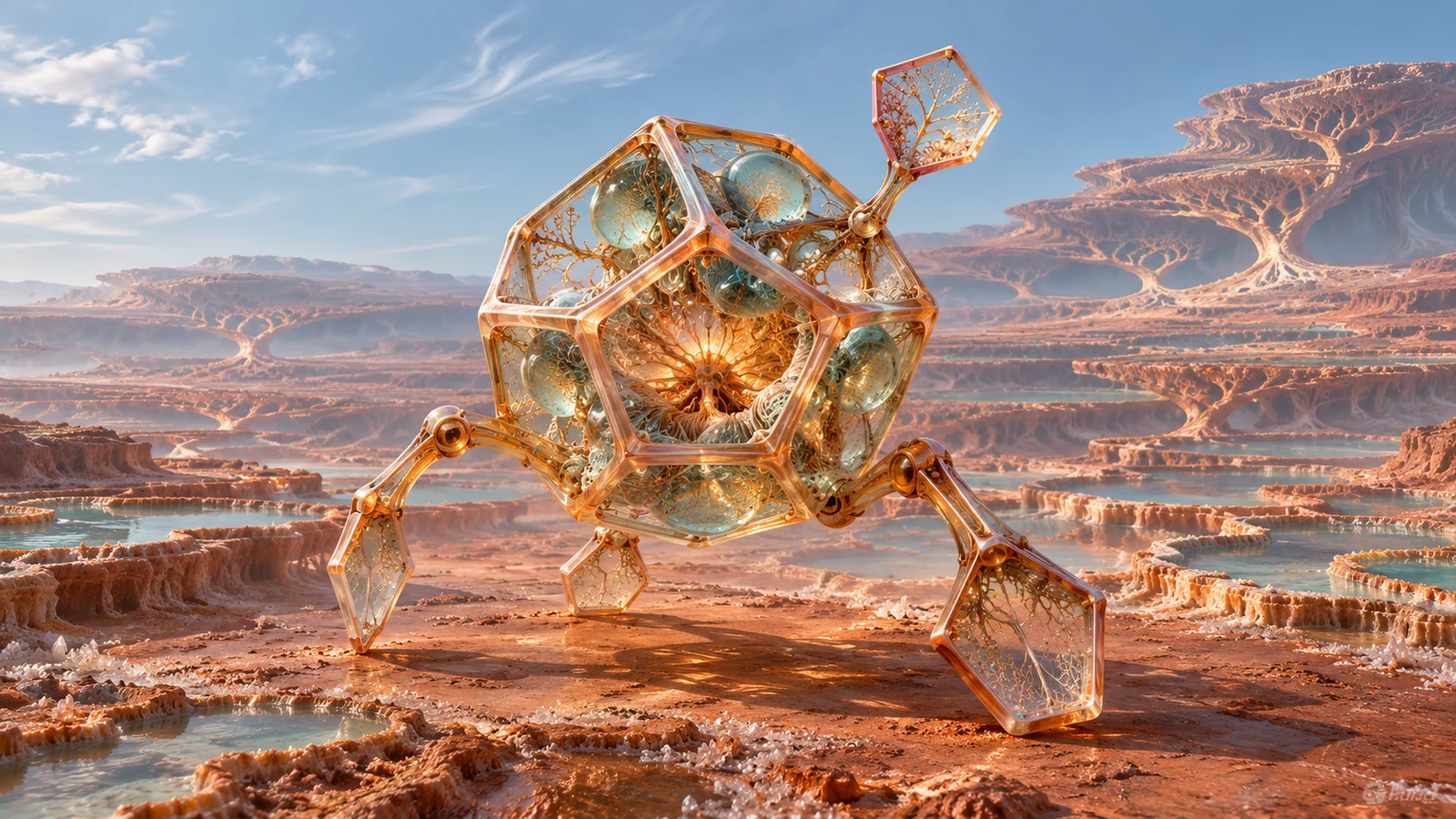
A crystalline geometric being in an imagined world governed by unfamiliar laws.
How different could reality be
When we look at the night sky, we usually imagine places far away. We wonder what planets orbit other stars, and whether someone on one of them is looking at their own sky right now. That thought is strange enough. Yet we can go further. We can ask what a world might look like if nature itself followed different rules.
Physicists often point out how remarkably well the constants of our cosmos suit stars, planets and life. With slightly different values, much of what we know would struggle to arise. I wrote about this fine-tuning and what it might mean in The Universe That Fits Us. If other universes exist, there are probably a great many of them. Some estimates in string theory suggest around 10500 possible vacuum states. Whether any of them is physically realized anywhere remains an open question. Our intuition seems to suggest something similar: such worlds would be numerous and profoundly different from one another. Most might be sterile. Even the handful left over, however, would be enough to stir our curiosity.
Can we imagine them at all? Our minds know only one world, and that world has shaped them. So we will give our imagination free rein, while asking it to meet some strict conditions.
In this essay I propose five thought experiments. We will give each world one clear physical rule, then follow its consequences far enough to meet one inhabitant and spend a day in their life. Along the way, we will keep track of the price each universe charges for existence. Every source has a finite reserve. Every message travels through a real channel and takes time. Every memory must be recorded somewhere, and its record must remain readable.
Let us make one qualification now, and only once. We choose the rules of these worlds ourselves, and the small calculations that accompany them apply to small examples. Everything we say about the inhabitants' lives, senses and inner experience comes from our imagination and remains hypothetical. The names we give them let us stay with one being long enough for its difficulties to become tangible. From here on, we can tell our stories freely.
One question will follow us throughout. However hard we try to imagine something completely different, we will recognize a few patterns from our own world in every world we visit. Is that a limit of our minds, or do some patterns belong to every possible reality? We will return to this question at the end.
Five worlds lie ahead. First comes the Scaleless World, where every being carries entire communities within it. Then comes Tetrion, whose space has one more direction than ours. In Foam, life unfolds on the walls between voids. Counterflow is a world where two peoples remember the same history in opposite directions. Finally, we reach Transmutation, where the very laws of nature change.
1. The Scaleless World
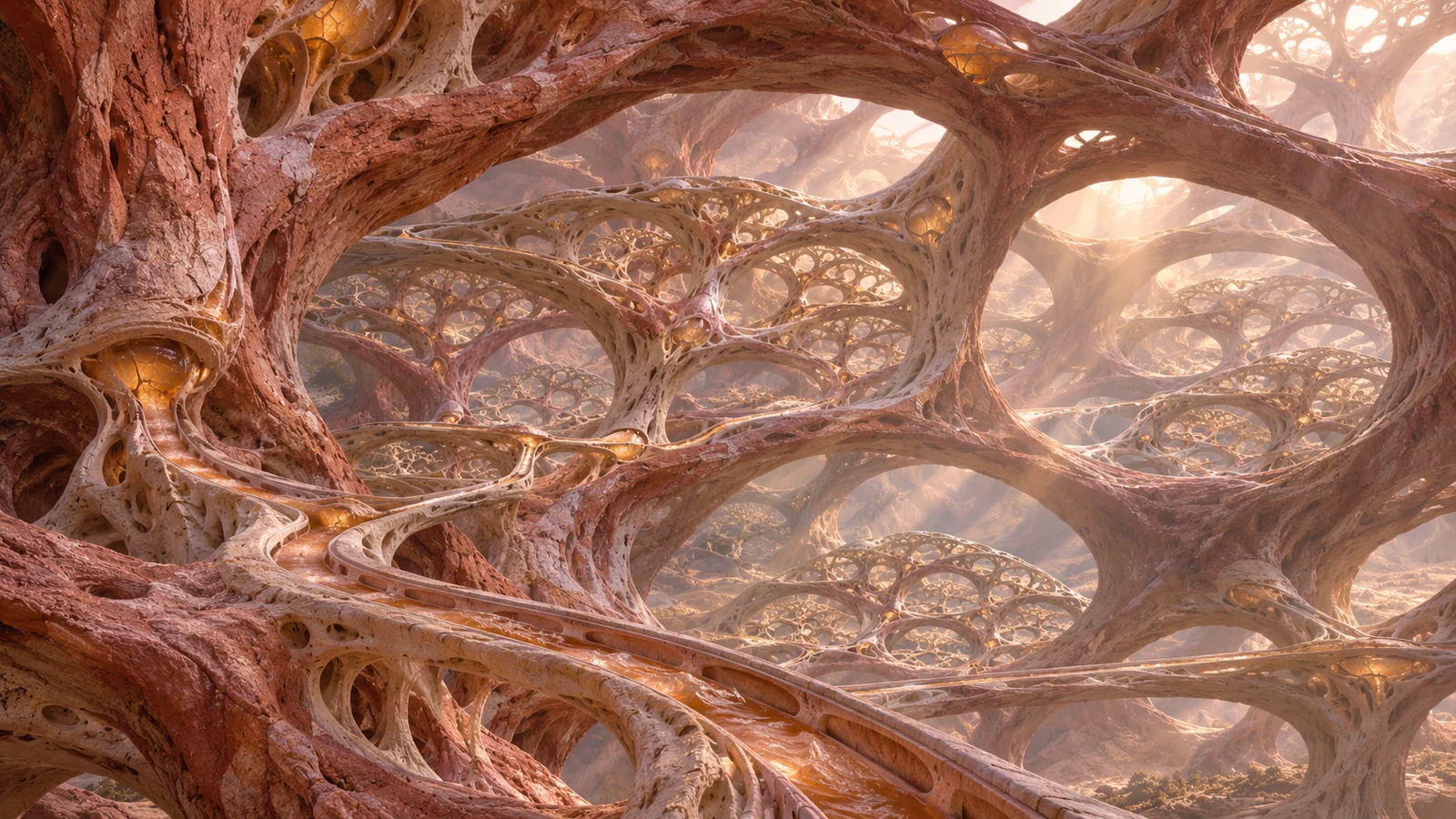
The Scaleless World at its largest scale. Connected habitats repeat a related structure across a finite sequence of levels.
Sela first sensed the silence. A faint murmur usually rose from one of her lower branches, like the humming of a hive that we stop noticing over time. Now it had fallen silent in one spot. Around that spot, it had grown denser and more urgent.
By the time she began to recognize the change, everything in the branch was already different. An entire community of tiny inhabitants lived there. They had noticed the crack in the wall of their passage immediately. They diverted flows of material around the damage and built a temporary barrier. Then they sent Sela a brief report. The senders knew that only those who came after them would live to receive her reply.
The report reached Sela as a single sharp prick. She decided to open a larger reserve and send work through the old passage, the one she remembered. That was where things went wrong. In the meantime, the original builders' successors had sealed the passage because the crack was advancing toward it. The work arrived at a blocked entrance. Some spilled into a neighboring cavity, where nobody was waiting for it, and dissipated there.
The new generation sent a second report, shorter and sharper than the first. This time Sela released the work more slowly, through a detour. The barrier held until it arrived. The community then spent several of its own lifetimes patching the wall. It remembered the lost delivery as a disaster from the distant past. For Sela, all this was one anxious conversation with a part of her own body.
For Sela, all this was one anxious conversation with a part of her own body.
The repeating rule
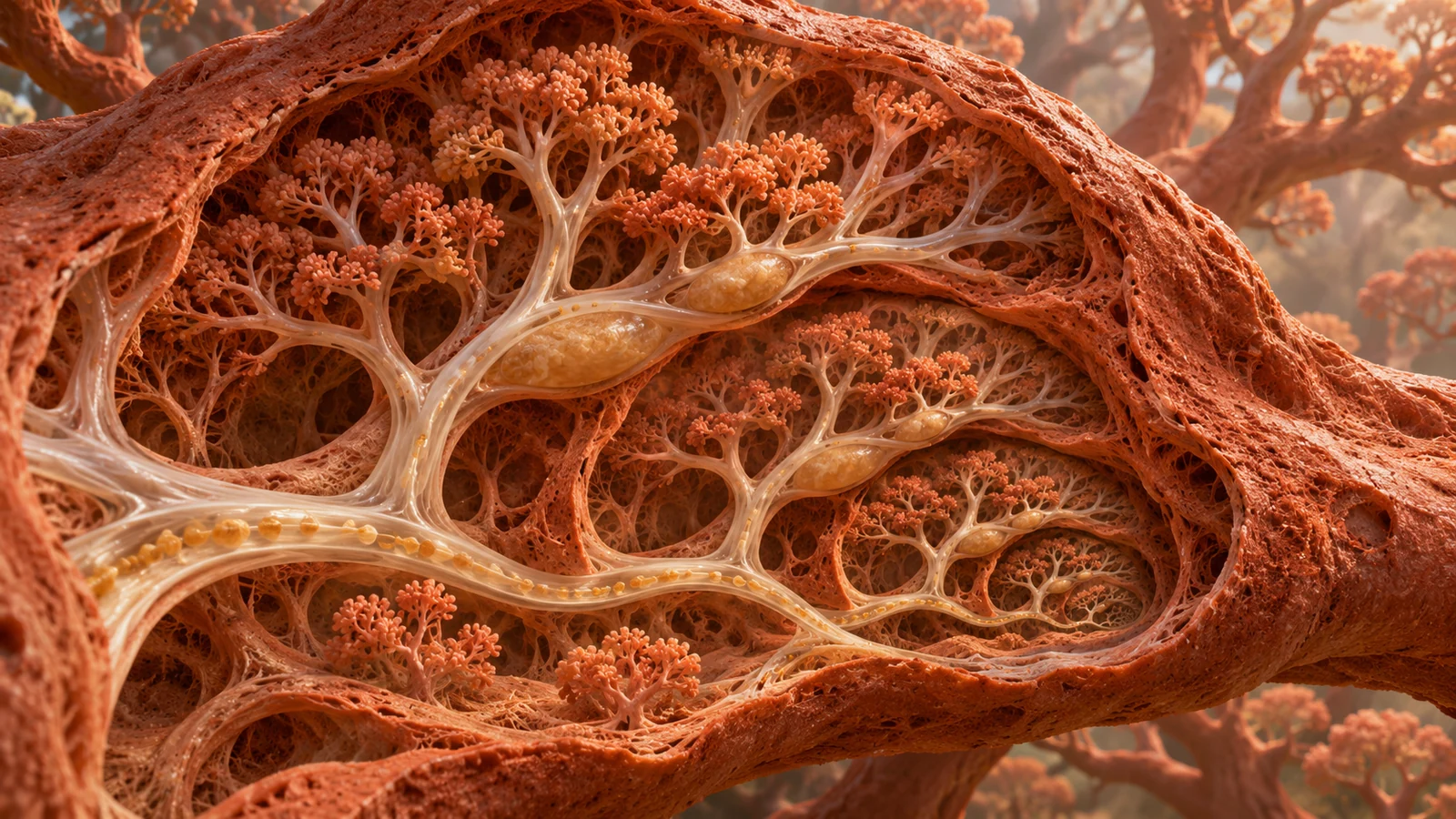
A branch and its smaller communities share a similar structure. Exchange between levels requires physical passages.
Sela is a Layerling. In her world, the same relationship between parts and whole recurs at several sizes. Let us look at a living being there and magnify a small part of its body enough. We would find an entire community, and each of its inhabitants would have a similar internal structure of its own. If we drew back, the first being would reveal itself as part of an even larger life.
We call this property self-similarity. In our example, a similar organization recurs whenever we magnify something fourfold. Messages always travel at the same limiting speed, so a path four times as long means a wait four times as long. In a compact notation, size L and cycle duration τ grow together: Ln+1 = 4Ln and τn+1 = 4τn. We choose four to keep the example easy to follow. The mathematics of this repetition at a particular magnification also exists in real science, under the name discrete scale invariance.
The consequence is simple and unyielding. In Sela's family, we follow four active levels. While the largest level completes one cycle, the smallest goes through sixty-four, because four times four times four is sixty-four. The different rhythms of life therefore follow from the world's very arrangement. Nobody chose them.
Of course, repetition in this universe comes to an end, unlike the repetition in mathematical fractals. We choose a finite series of levels, with lower and upper bounds beyond which this description ceases to apply. Each inhabitant also uses a definite amount of material. Its bodily boundaries show us how far the repetition is actually sustained.
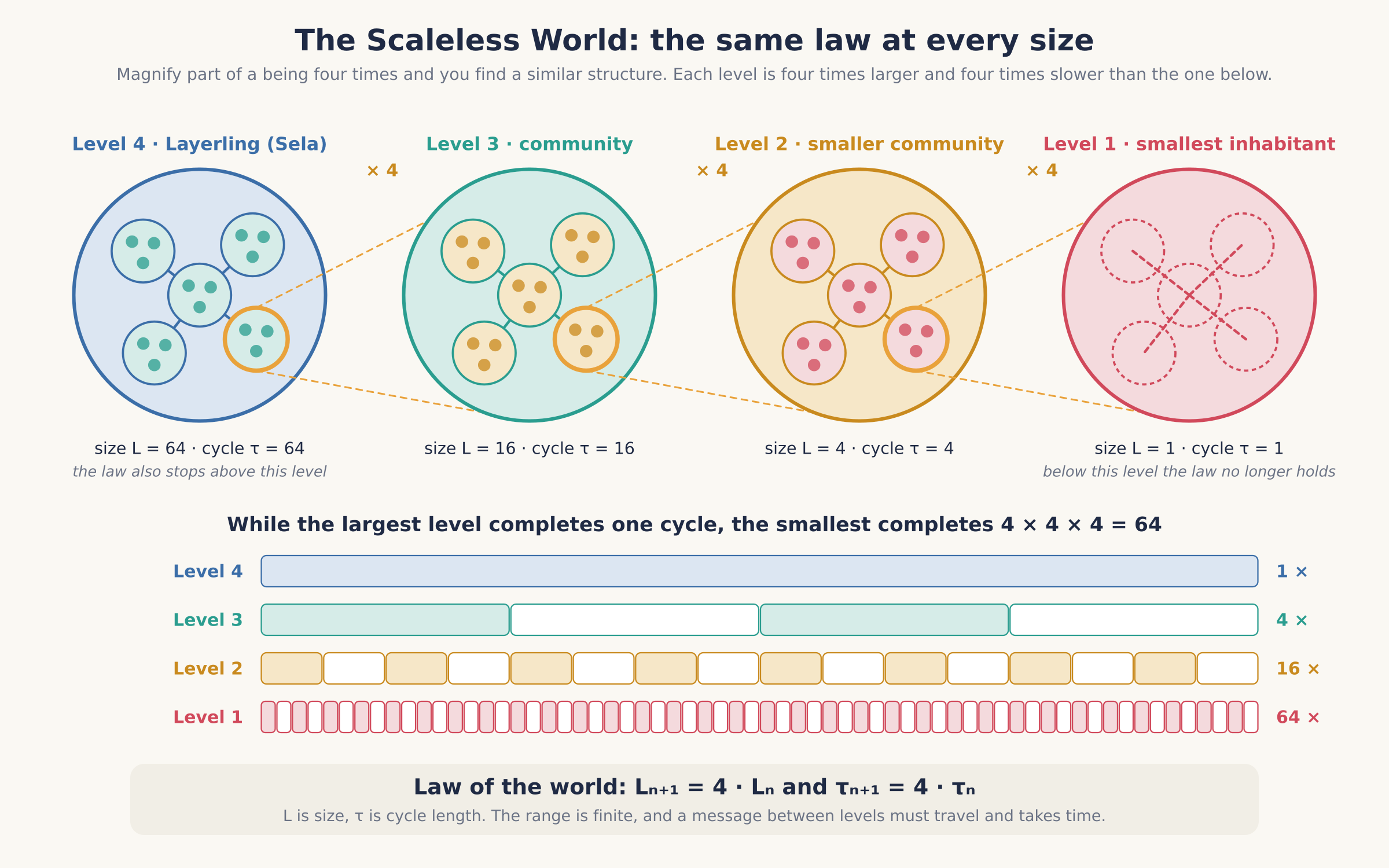
A schematic of the world’s rules. The supplied author’s diagram is reproduced unchanged.
A home on many levels
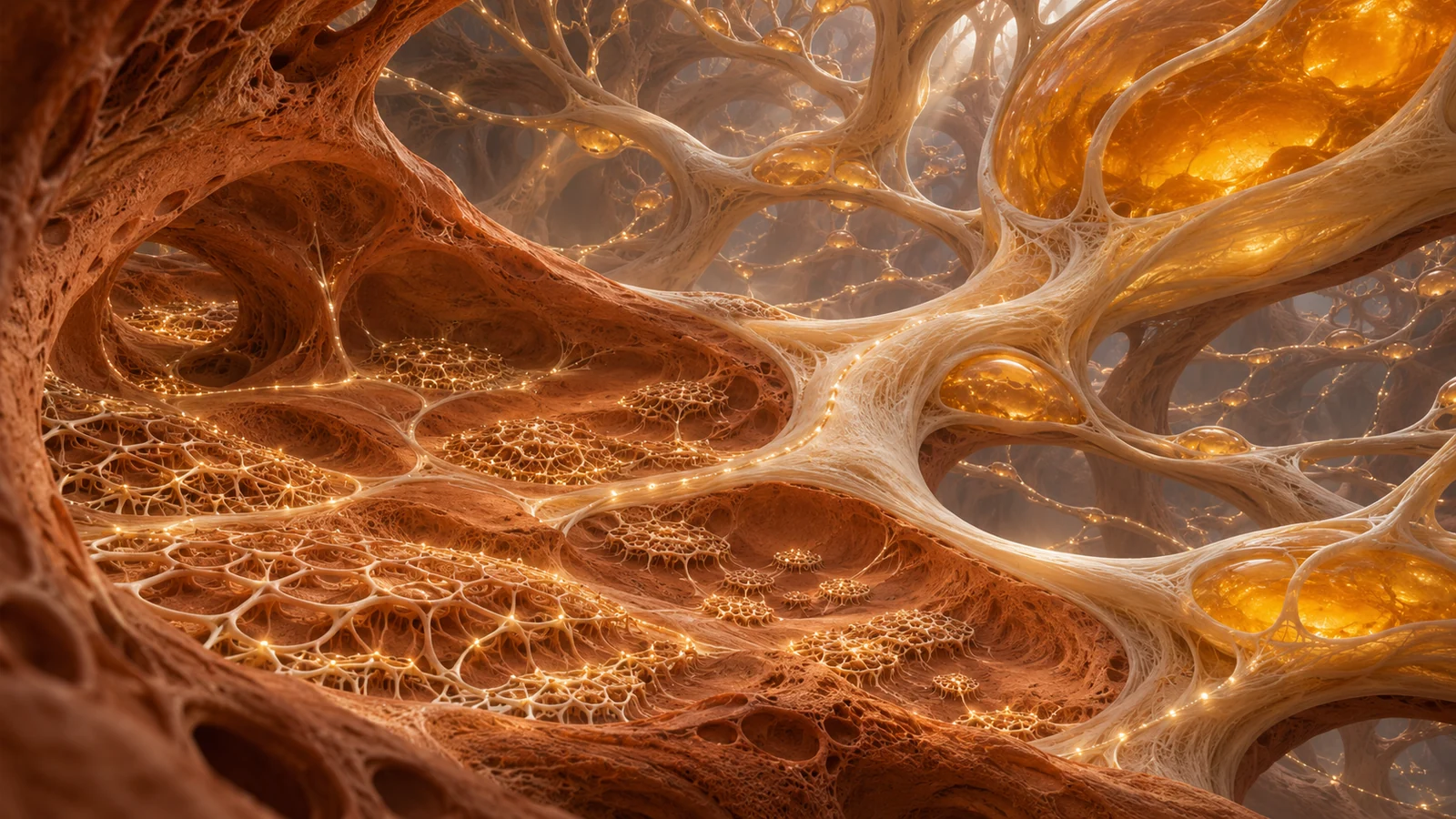
The Layer habitat connects smaller passages to larger reserves. Foci supply the surrounding network from finite stores.
We call the largest whole in the Scaleless World the Great Layer. A close look at its fabric would reveal a network of smaller habitats. A more distant observer would recognize it as just one part of an even larger structure. The Great Layer would thus resemble a galaxy in our universe, although that comparison makes sense only once we specify the level from which we are looking.
Work flows through this hierarchy by way of focal sources. From a distance, we might describe them as counterparts of our stars, on a structural level below that of a galaxy. Each focal source has a finite capacity, a fund that is spent through exchange. To a tiny inhabitant, its source lasts an entire lifetime. To a community on a larger level, the same event looks like a brief flicker in one part of its body.
Sela's habitat is called Layer, the counterpart of our planet, and spans several connected levels. A smaller level carries out fine repairs, while a larger one holds slower, bulkier reserves. This division of work can succeed, and it can fail. Its survival depends on actual exchange through the passages, just as we have seen.
What counts as one being here
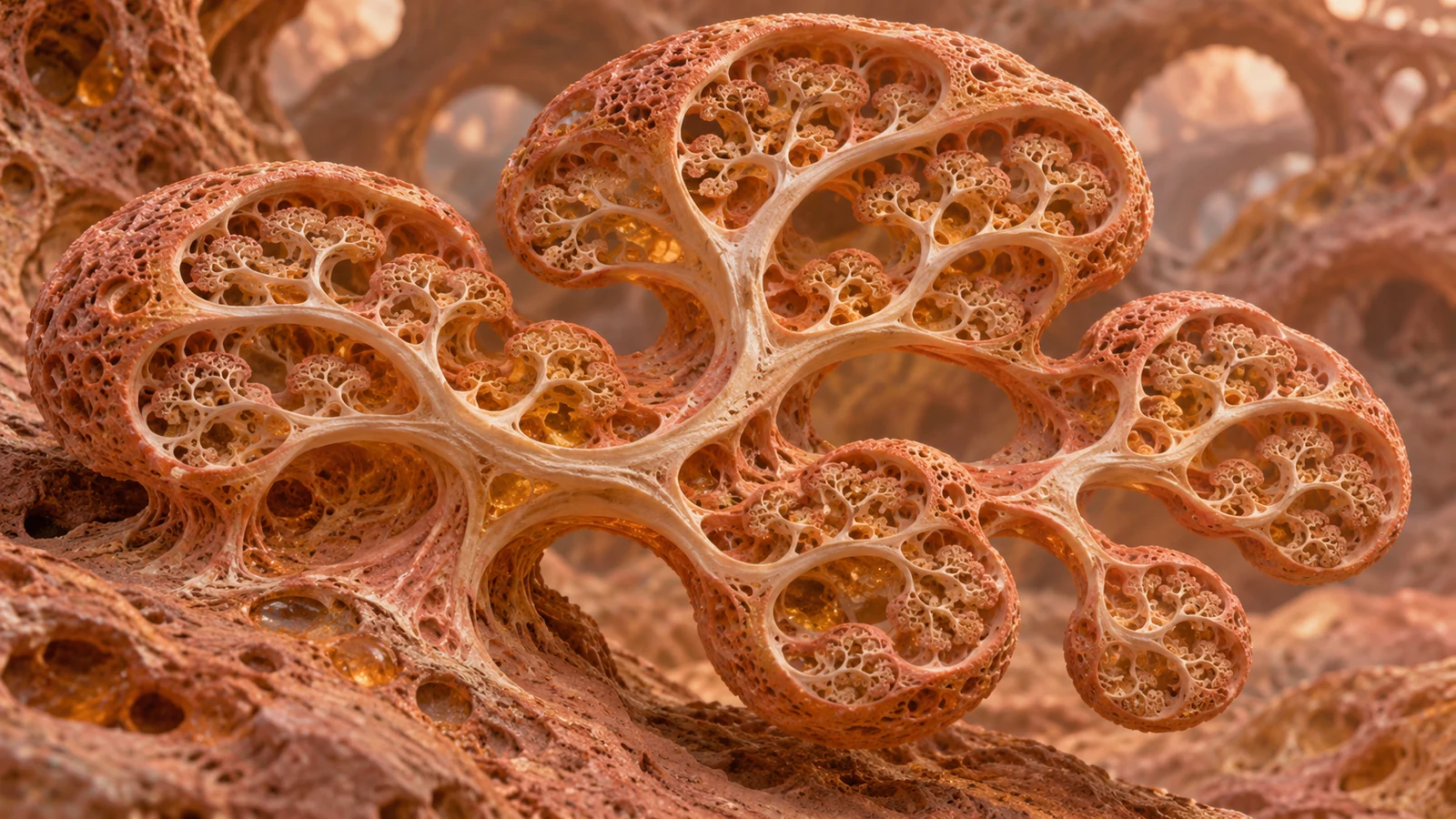
Sela, a Layerling. Open parts of her branching body reveal smaller communities linked into a whole.
A Layerling's branching body repeats a similar structure in many places. Cavities in its larger parts house smaller systems with their own much faster activities. We imagine such a being's senses as a kind of listening inward: the murmur of communities, a blockage in a passage, a delivery running late. The memory of the larger whole rests in enduring relationships among these communities. Recollection therefore requires exchange between them, and Sela must literally wait for a memory.
Let us look at the same life from below. To a tiny inhabitant of Sela's branch, she is both ground and sky. Her voice arrives rarely, once in many generations, always answering some ancient question the ancestors asked. Children in that community would therefore learn two skills. The first is reading old messages. The second is writing new ones so that someone living among wholly altered passages can understand them.
A Layerling's offspring comes into being when one community separates, receives enough material and establishes its own maintenance on every level it uses. Death is just as layered. Severe damage may end the life of the whole while some of its tiny inhabitants go on living elsewhere. I think this raises an unusual question about the boundaries of a self. Does Sela have an experience, or do her communities, or do all of them at once, each at its own pace? Where does an individual's experience begin and end? In my view, these questions may apply to our world too. Perhaps they do so to a lesser extent, but their importance is clear.
Layerling culture would have to take other beings' time into account. A large neighbor on a higher level replies only after many local events have passed, so patience is a basic form of courtesy here. It seems to me that such a world would value, above all, the reliable handing on of unfinished work.
Do we have anything in common?
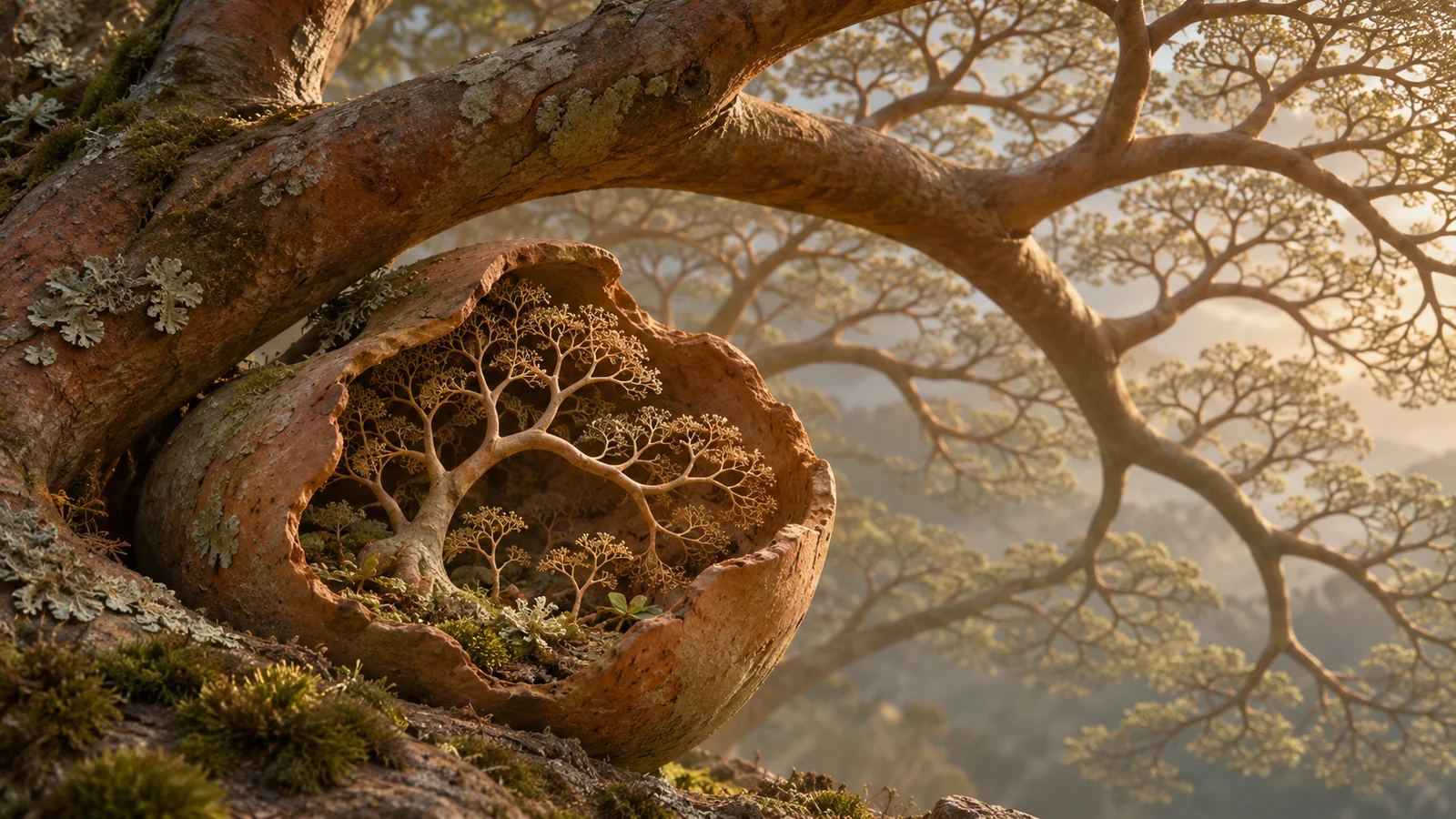
A repeated branch invites us to consider parts and wholes. Similar forms help us compare different scales.
Does this world seem to bear a strange, allegorical resemblance to our own? There are fractals, with patterns that repeat at every level, and hierarchical structures, so widespread in our society. Or we might think of higher and lower layers of reality that struggle to communicate while influencing each other in deep and subtle ways. More intriguingly still, might the holographic principle1 be a subtle feature of our own world, as it is, in its particular way, of this one?
2. Tetrion
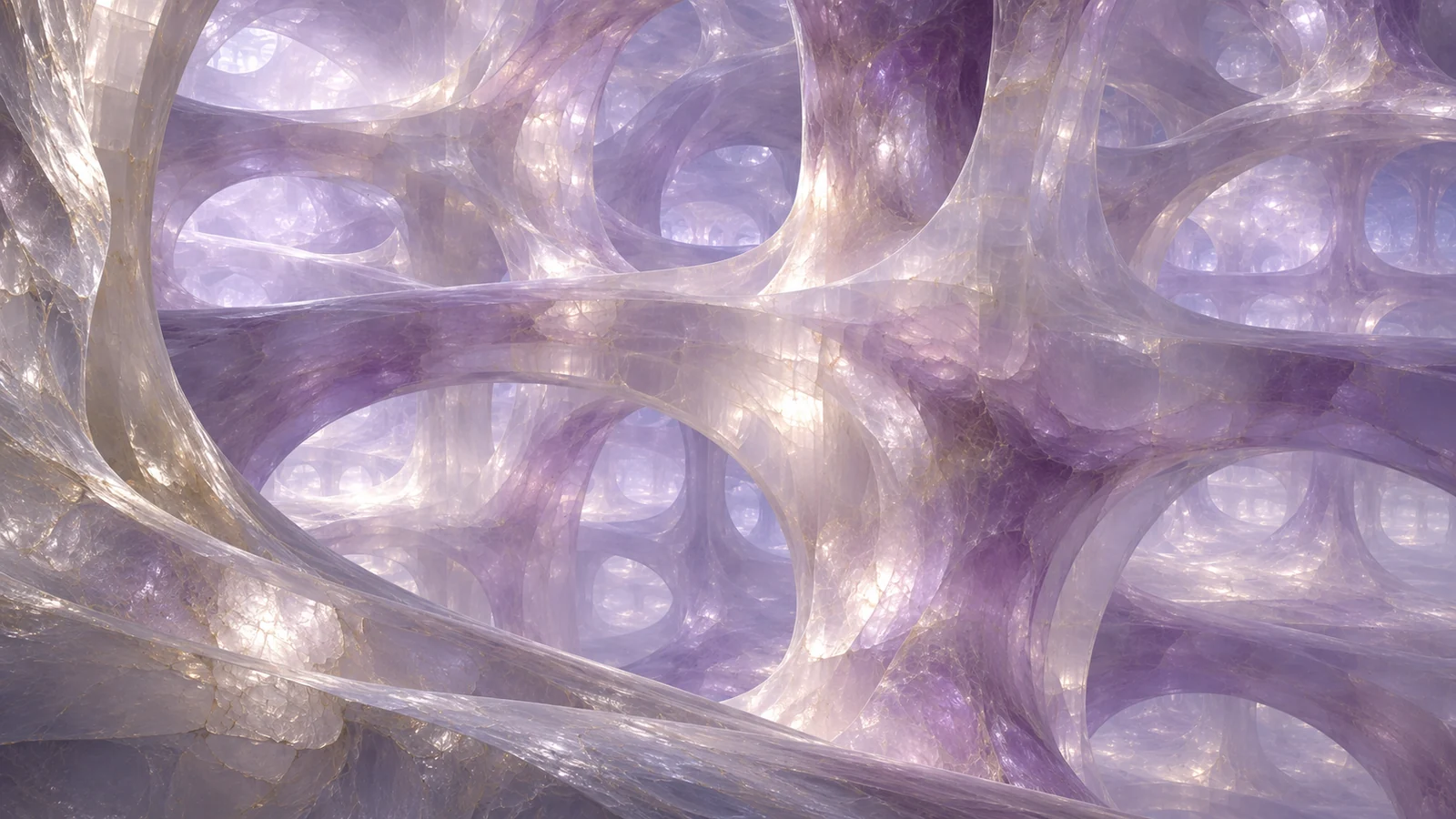
Tetrion on a vast scale. A projection of connected three-dimensional slices helps us follow the additional spatial direction.
Take a sheet of paper and imagine a being with no thickness living on it. For that being, only forward, backward, left and right exist. Draw a closed circle around it. As it goes around, it encounters the line everywhere, so the circle is a perfectly enclosed space. Now lift a coin above the paper and lower it straight into the middle of the circle. The coin is inside, and the line remains intact. The paper-dweller would struggle to understand what had happened. The direction from which the coin arrived has no name in its world.
A similar relationship would hold between our space and Tetrion, a four-dimensional world. There, a body's position is specified by four spatial coordinates, while time runs separately, just as it does for us. Every body extends along an additional direction, which we will call the fourth. Every wall must therefore close off that direction too.
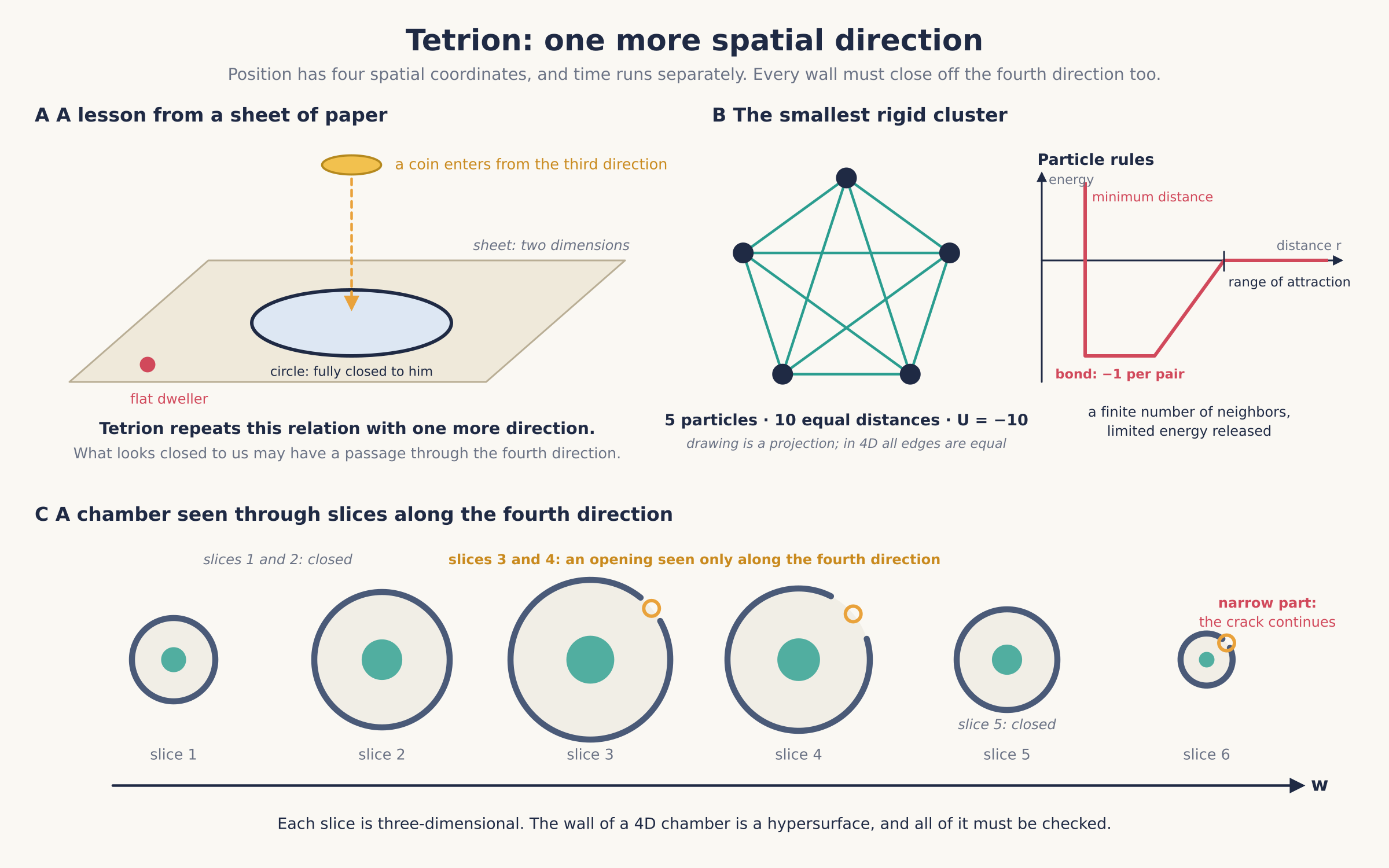
A schematic of the world’s rules. The supplied author’s diagram is reproduced unchanged.
How we see it
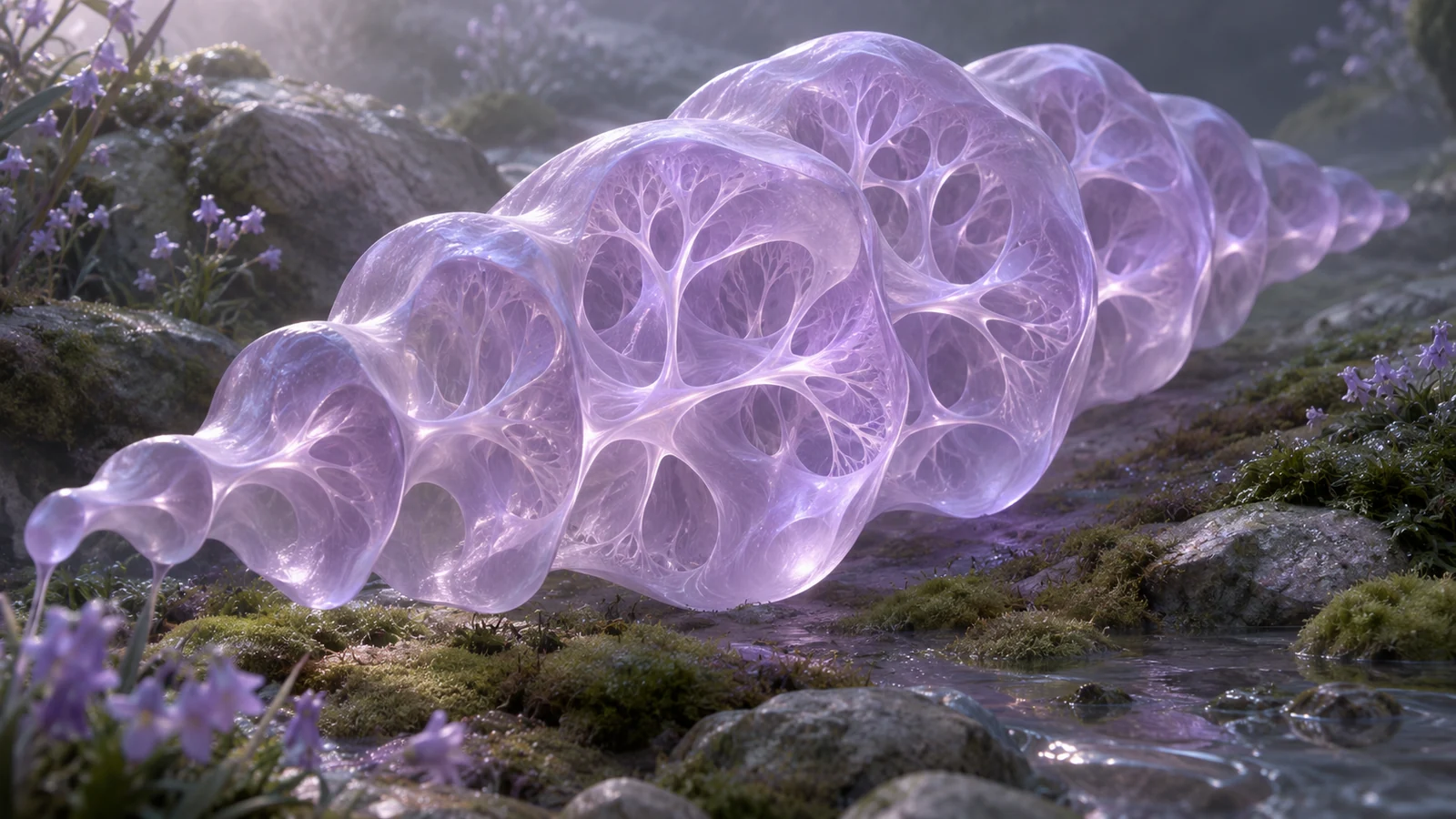
One body is shown through connected neighboring slices. Their differing shapes belong to the same structure.
We call an inhabitant of this world a Tetran. We can neither draw nor imagine it in its entirety, so we use slices. A slice is one three-dimensional section of its body, just as a slice of bread is a section of a loaf. As we move the slice along the fourth direction, its shape changes. Some parts of the body suddenly appear, grow and vanish. For the Tetran itself, they all belong to the same connected fabric and remain in their places throughout.
Its senses also depend on physical transmission. The additional direction opens new paths, and each takes time to travel. Sensors gather different slices of the surroundings and combine them into one picture. A Tetran learns its own shape through weak excitations that pass through its body and return in a familiar order. When that order changes, it knows that some part has moved. Imagine the sensation as the sound of our own footsteps, in which one day we hear an unexpected echo.
It stores memories in stable bound states of its fabric. Its offspring must build a body of its own, together with its own closed boundary, which is a much more demanding task.
What it is made of
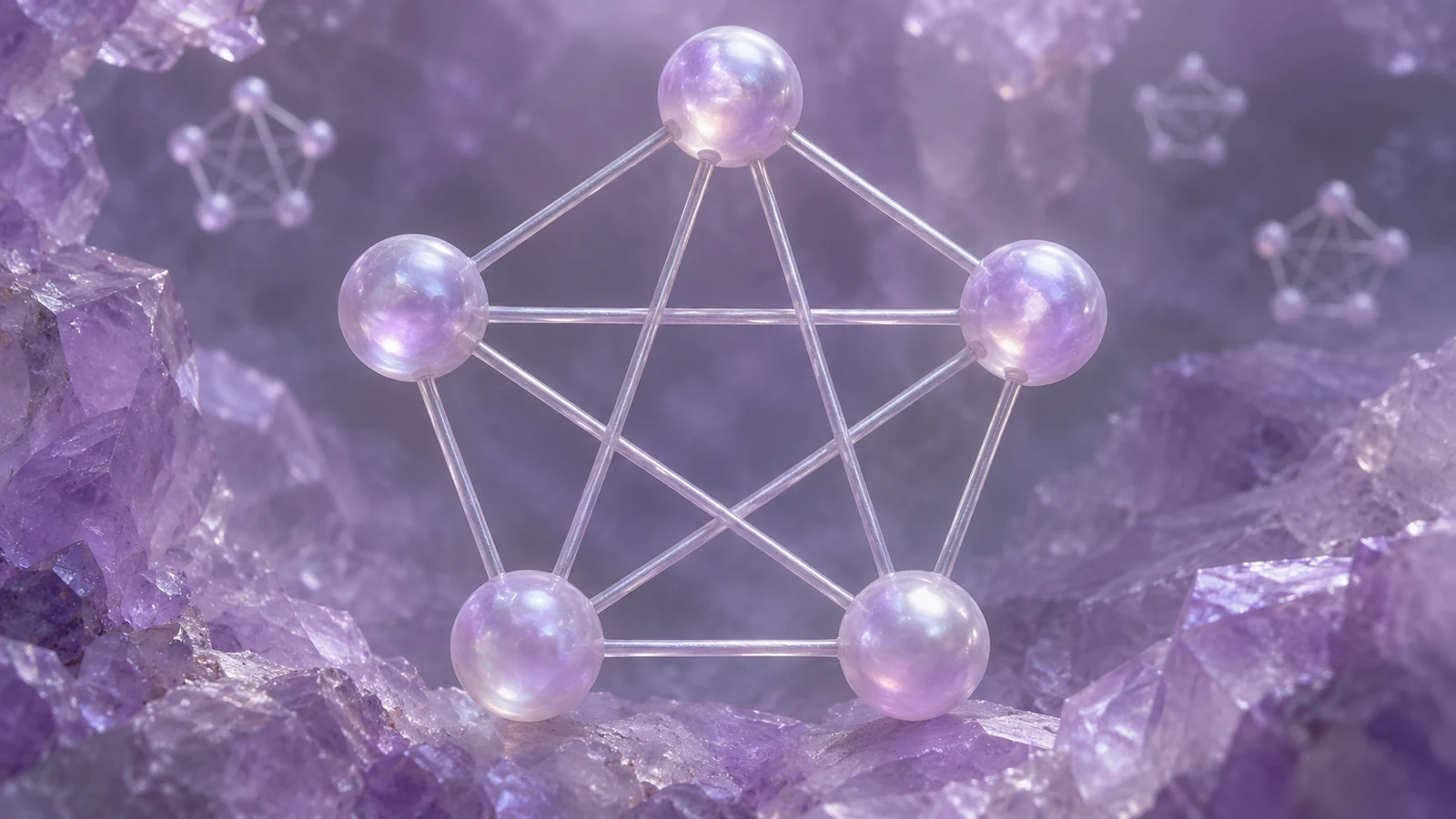
A projection of a small bound cluster in Tetrion. Five particles form ten bonds; the image presents a spatial model.
For such a body to exist at all, matter must bind into lasting structures. We therefore give Tetrion's particles two rules. The first is a minimum allowed separation: two particles cannot come any closer than that. The second is an attraction of limited range and strength. These two rules mean that only a finite number of neighbors can fit around any one particle. They also mean that binding can release only a limited amount of energy. The particles have internal states as well, and the sources of energy will depend on those.
Interestingly, the smallest framework for this kind of matter consists of five particles. In four dimensions, five points can be arranged so that each is equally distant from every other. This is a four-dimensional simplex, a relative of the triangle and the tetrahedron. Five points give ten pairs, and all ten separations are equal. When we place that separation at the minimum of the attractive potential, we obtain a locally rigid structure with an energy of −10 in our chosen units. The negative number means that the bound structure has less energy than five scattered particles. The difference has to go somewhere, so the surroundings take it up.
Of course, there is a long way to go from one rigid framework to a body. Still, this is a first foundation stone that we have checked.
Hypera
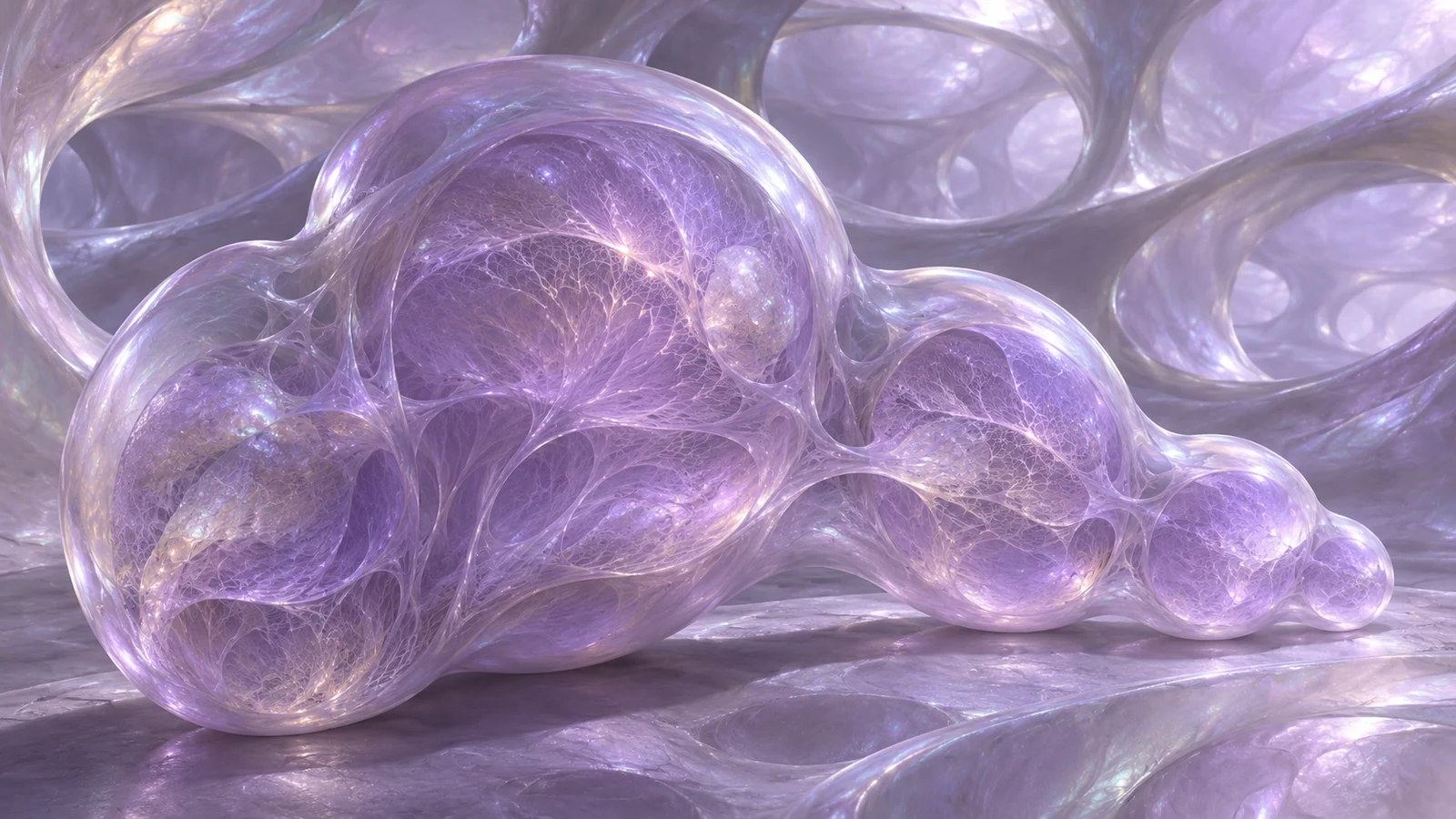
Ilan, a Tetran in Hypera. Neighboring slices of body and habitat show our attempt to represent the fourth dimension.
Tetrion's energy sources are regions whose particles occupy excited internal states. As they pass into lower states, they release some energy into their surroundings, and the inhabitants sustain their bodies with that supply. Naturally, the initial reserve determines how long a source can support them.
Our habitat is called Hypera. It is a large bound structure with internal passages. Its interior is four-dimensional, so the boundary of that interior is three-dimensional. I think this is the hardest idea in this world, so let us pause over it. Our minds, accustomed to three spatial dimensions, find it difficult to imagine. In our world, a room's wall is a surface. In Tetrion, the wall is an entire volume, a hypersurface, and the builder must close all of it. What looks to us like a perfectly sealed box may easily leave a route open along that fourth spatial direction.
The greatest danger here is therefore a particular kind of injury. An opening visible only from the extra direction disrupts exchange with the surroundings, even though all the usual slices look sound. That was how trouble began for our imagined protagonist, Ilan.
*
Ilan reached the familiar chamber and sent a probe along its usual slice. The enclosing wall gave a clear response, as it always did. A second probe, shifted along the fourth direction, reached the internal structure earlier than he expected. Too early, and without an echo. Somewhere, a passage had been left open, probably during the last repair.
He called the chamber's owner through an external channel. Together they followed neighboring slices, one at a time. In the third, the opening was a narrow crack. In the fourth, it was wider. In the fifth, it was gone, so they concluded that they had found the whole edge. They prepared a new protective hypersurface and sealed it.
The last probe returned too early again. The crack continued beyond the fifth slice, into a part of the chamber so narrow that neither of them had examined it. A second patch would need more material, and their shared reserve had gone into the first. The owner went to look for material nearby. Ilan stayed beside the chamber. Every few beats he sent the same probe along the fourth direction, listening as it returned too early.
*
A home with every approach secured
Examining a chamber boundary. An opening appears only in neighboring slices along the additional direction.
To be safe, an imagined home in Tetrion must secure every actual route of entry. A partition that encloses space in our drawing may leave an opening along the fourth direction, so the builder must follow the habitat's entire three-dimensional boundary. As in our world, privacy depends on how well the host knows every approach and how they open it to a guest. Art, moreover, could guide a viewer through carefully chosen slices. The order of discovery itself would become part of the work.
Four-dimensional space has received much attention in mathematics, physics and science fiction. Still, I think it would be a pity for this article to leave out a cosmos with such properties: strange and still hard for our minds to grasp, even with physical laws somewhat similar to our own. We might wonder how entirely different laws would work in such a space!
3. Foam
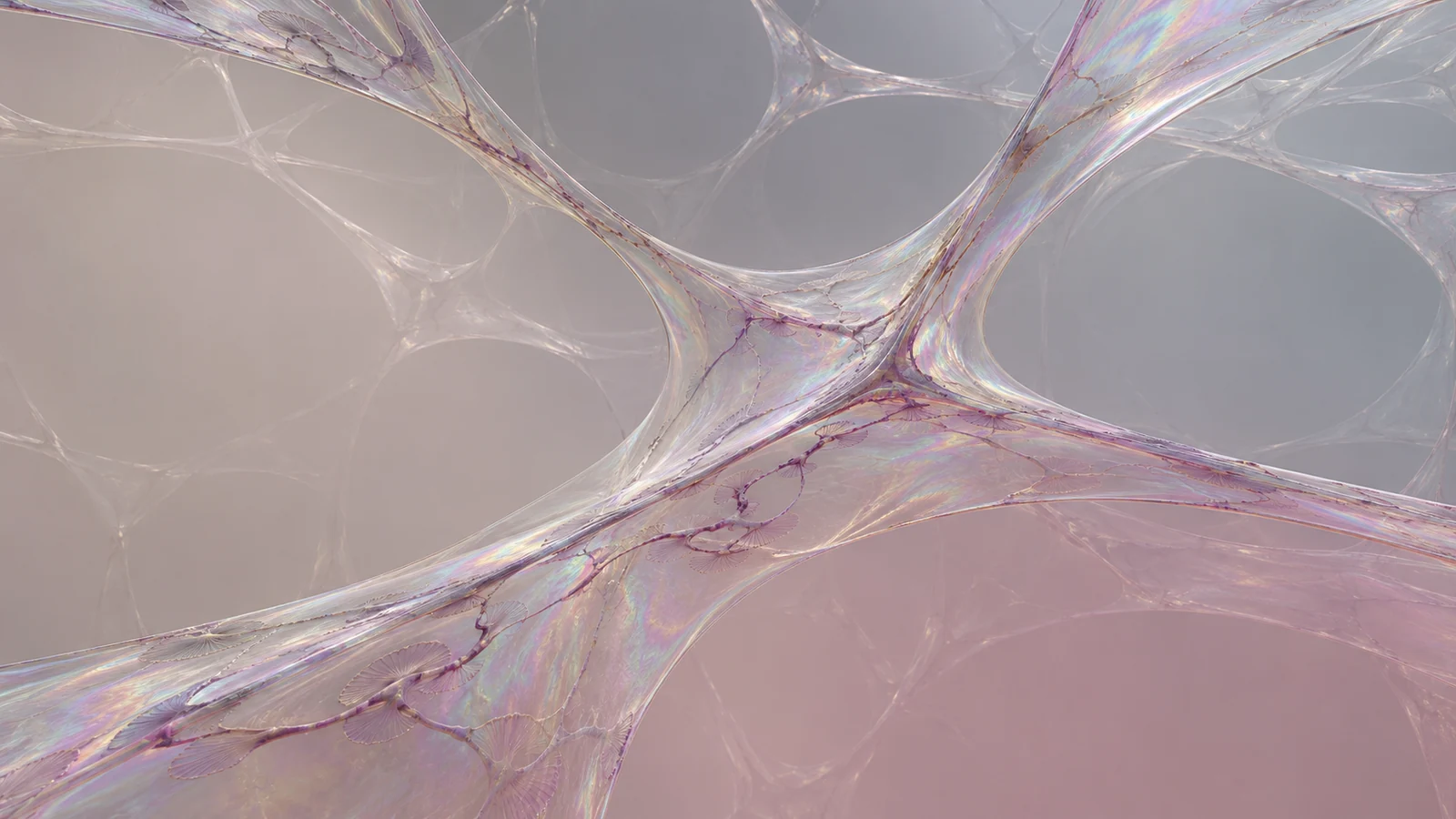
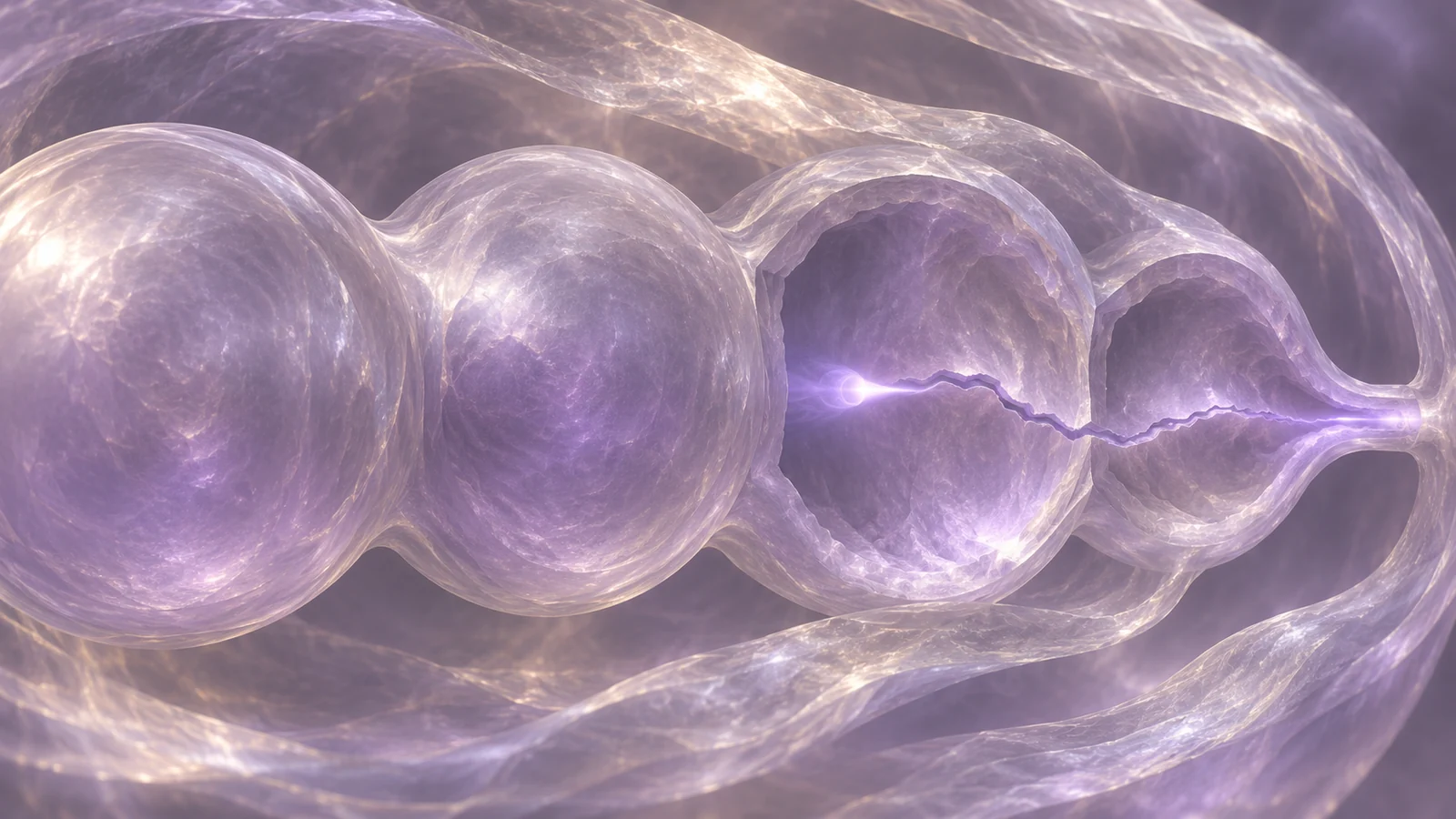
Foam at its largest scale. Nearly empty cells are separated by membranes where life takes place.
Imagine an immense foam, larger than anything we know. To its inhabitants, the cells are almost empty. All life unfolds on the walls between them. What we would see as a thin partition is, for them, an entire country, with roads and neighbors of its own. The way to the next country lies across a junction, where membranes meet.
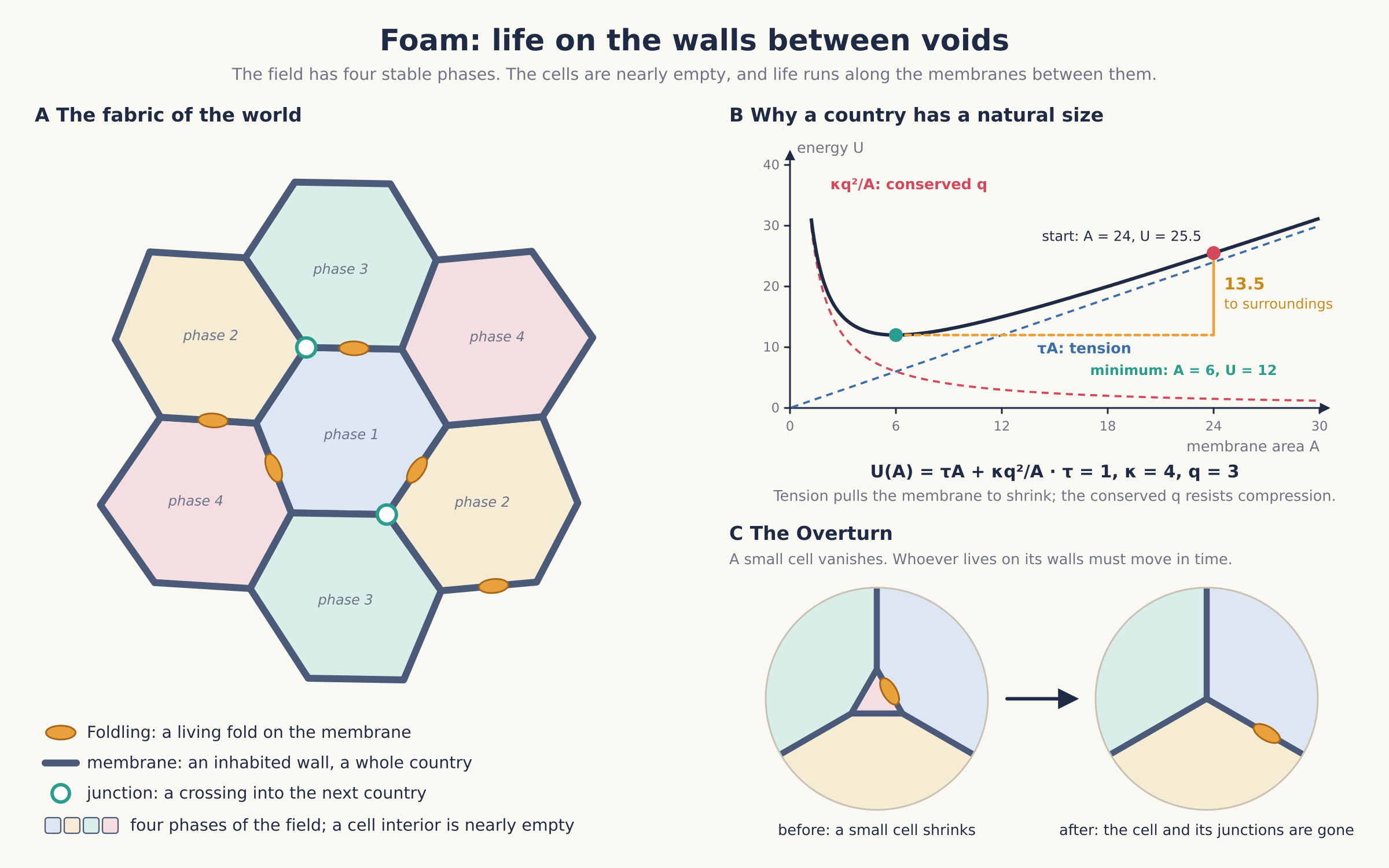
Why does this universe have a foam-like structure? Let us imagine its physical basis this way. The field filling this world can occupy four different stable states, which we call phases. Each cell of the foam is a region of one phase. The boundary between two regions has energy of its own and can carry excitations bound to its surface. Real physics includes models in which particles remain bound to such a lower-dimensional wall. To this idea we add a long-lived network of membranes and processes that endure on them.
On the largest scale, then, home is one great cell with its walls. A whole connected region of membranes plays the role of a galaxy. A traveler cares only about surface routes and places where crossing a junction is allowed. The void on either side of a wall is, for that traveler, what the depths beneath Earth's crust are for us.
A schematic of the world’s rules. The supplied author’s diagram is reproduced unchanged.
How large can a country be
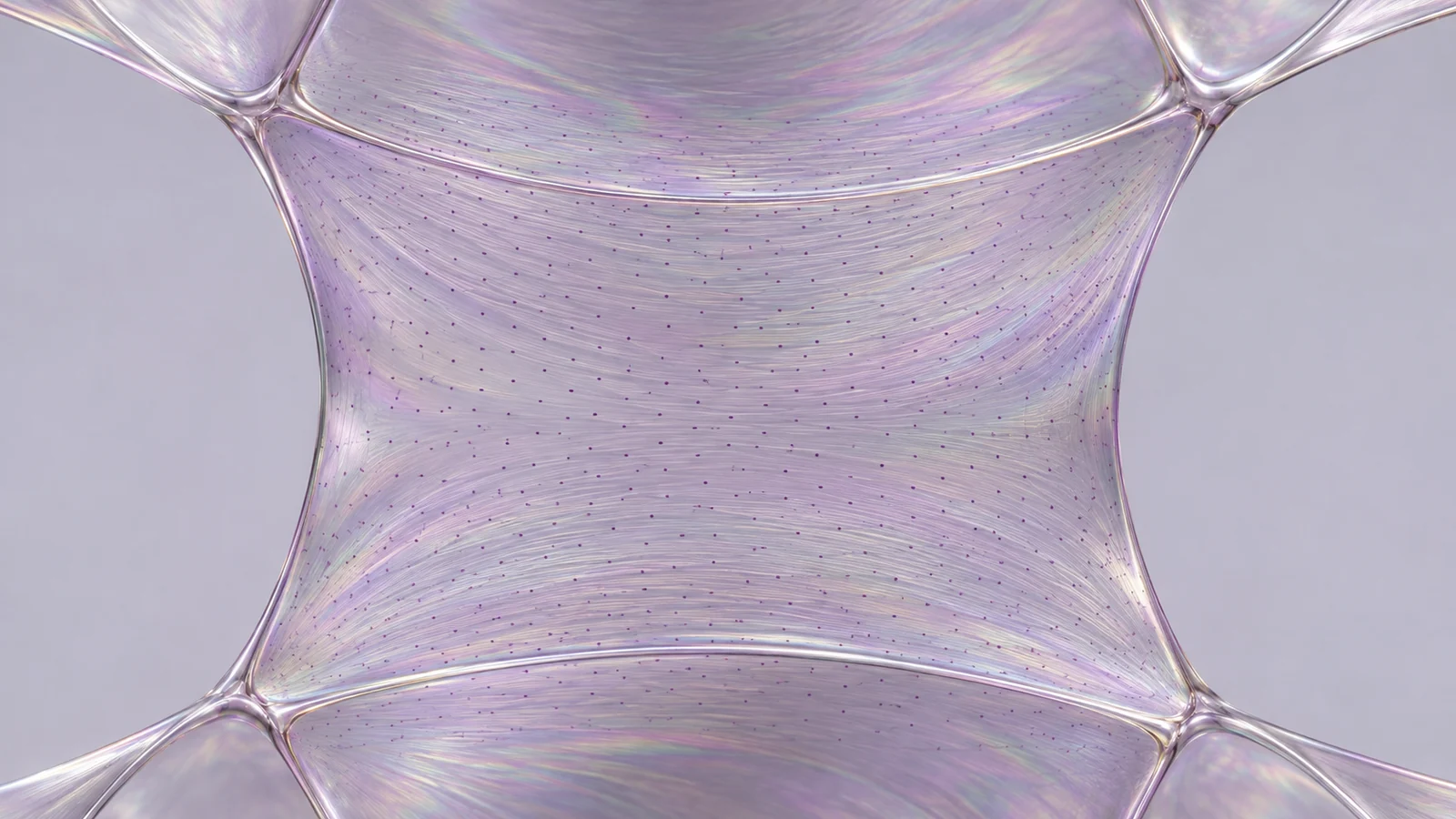
A taut membrane carrying distributed surface structures. Its size depends on two opposing energy requirements.
A membrane has tension, so it tends to contract, like a stretched skin. If that were all there was to it, every country would gradually disappear. We therefore distribute a conserved quantity over the membrane and denote it by q. It stays the same whatever happens, and compressing it into a small area comes at a high cost.
We write the energy of an isolated piece of membrane with area A as U(A) = τA + κq2/A. The first term increases with area. The second increases as the area shrinks. Somewhere between the two, there is a size at which these demands balance.
Let us look at the numbers. For τ = 1, κ = 4 and q = 3, the most favorable area is A = 6. A membrane starting with an area of 24 has an energy of 25.5. As it relaxes to an area of 6, its energy falls to 12, and the difference of 13.5 passes into the surroundings. The country has acquired a natural size. Yet that calculation applies to one quiet piece of membrane. The entire foam shifts slowly, and that is where its inhabitants' troubles begin.
Foldlings
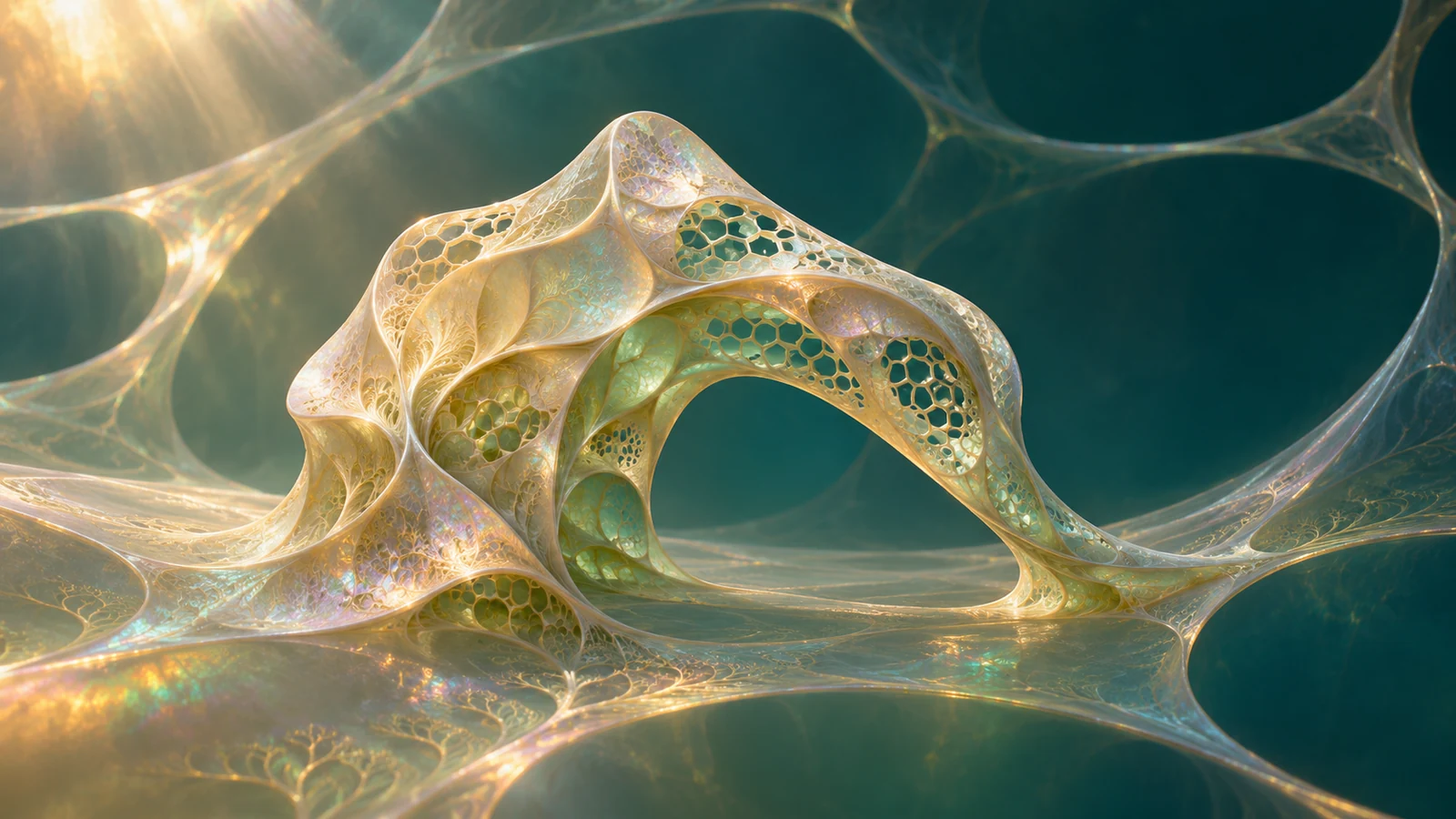
Savaj, a Foldling or Membraner. His folded body remains part of the membrane on which he lives.
We call an inhabitant of Foam a Foldling. It is a living fold in a membrane, a self-maintaining pattern of surface excitations. When we speak of its relationship to the surface supporting it, we also call it a Membraner. Naturally, many different species of these creatures exist. Here we will describe only what the great majority have in common.
Every Foldling senses the world along its entire length. It feels a wave arriving across the membrane as a tremor, and a change in tension as a tightening or slackening of the ground beneath it.
It stores memories in lasting patterns on the surface. To recall something, it sends a weak probe toward a pattern and waits for the response to return to the active part of its body. A memory therefore has both an address and a route. A longer route naturally means a later recollection.
A memory therefore has both an address and a route. A longer route naturally means a later recollection.
The inhabitants of Foam obtain the energy for life from focal sources, the counterparts of our stars. In this universe, these are strained folds and junctions that gradually release reserves stored long ago. When a source is exhausted, the surface remains in place, but life on it becomes difficult. An offspring receives some of the carriers of the conserved quantity q, while acquiring an arrangement of its own, a unique structure capable of sustaining itself. An individual dies when its renewal stops. Some of its patterns may remain on the membrane for someone else to read later.
The Overturn
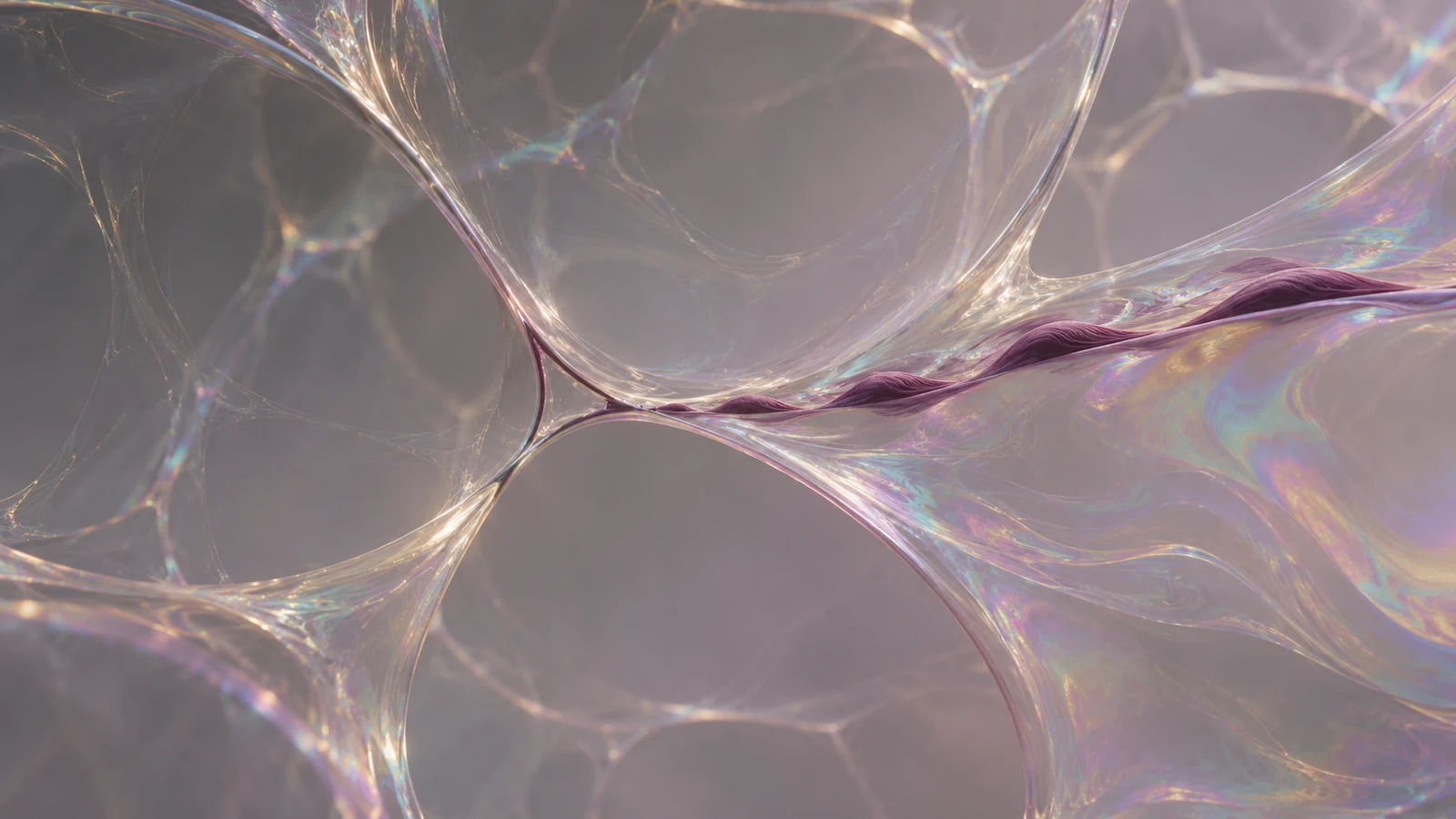
The Overturn approaches. A small cell contracts as surface patterns cross a junction onto a neighboring membrane.
This world's greatest fear has a name. Small cells in the foam gradually contract while their neighbors expand. At some point a junction, or an entire cell, ceases to exist. This is the Overturn. An old route to the neighbors disappears, while another junction creates a new proximity. Foldling history remembers Overturns as we would remember the disappearance of continents and other great natural catastrophes.
Their settlements therefore watch for early signs of rearrangement, adapt to them and prepare in time. Before an Overturn, a neighboring habitat must be made ready. Everything that can live must be transferred there, with enough carriers of q and enough available work.
We can also imagine a particular craft: the passage-keepers. They know the mechanics of membranes, and the habits of everyone who reads memories across a given seam. A smaller version of the same task faces anyone when a public seam is repaired. This once happened to a Foldling we will call Savaj.
*
On the public seam, Savaj recognized the signal announcing a repair. He felt it as a small, regular tapping in the membrane. One of his old memories lay on that very patch of surface. He chose a new spot, farther from the seam, and began transferring the pattern, fold by fold.
After each step he sent the same probe to both records. The old one answered quickly and clearly. The new one took longer, but repeated the same shape. Then a long, slow wave passed along the membrane from a contracting cell. The fresh pattern blurred. Savaj sent a probe and received a muddled response, with the beginning missing.
He started again. The tapping from the seam was growing more frequent. The workers waited patiently for his consent. The second transfer reached the end, but the first two folds remained uncertain, and there was no time for a third attempt. He sent his consent.
During the repair, the familiar patch of membrane changed its fold and the old pattern disappeared. Savaj then accessed the new one. The response traveled much longer than he was used to. The middle of the memory arrived, and so did its end. Where the beginning should have been, only a flat vibration returned. Savaj marked the new route in his own arrangement and sent another probe.
*
Contact between two Foldlings changes the surface they share, so an encounter begins with weak probes and a slow approach. Their art could take the form of a wave of carefully prepared folds, followed by several participants from different places. I think such a civilization would prize above all the skill of preserving a shared surface for many different lives.
How different are we, really?
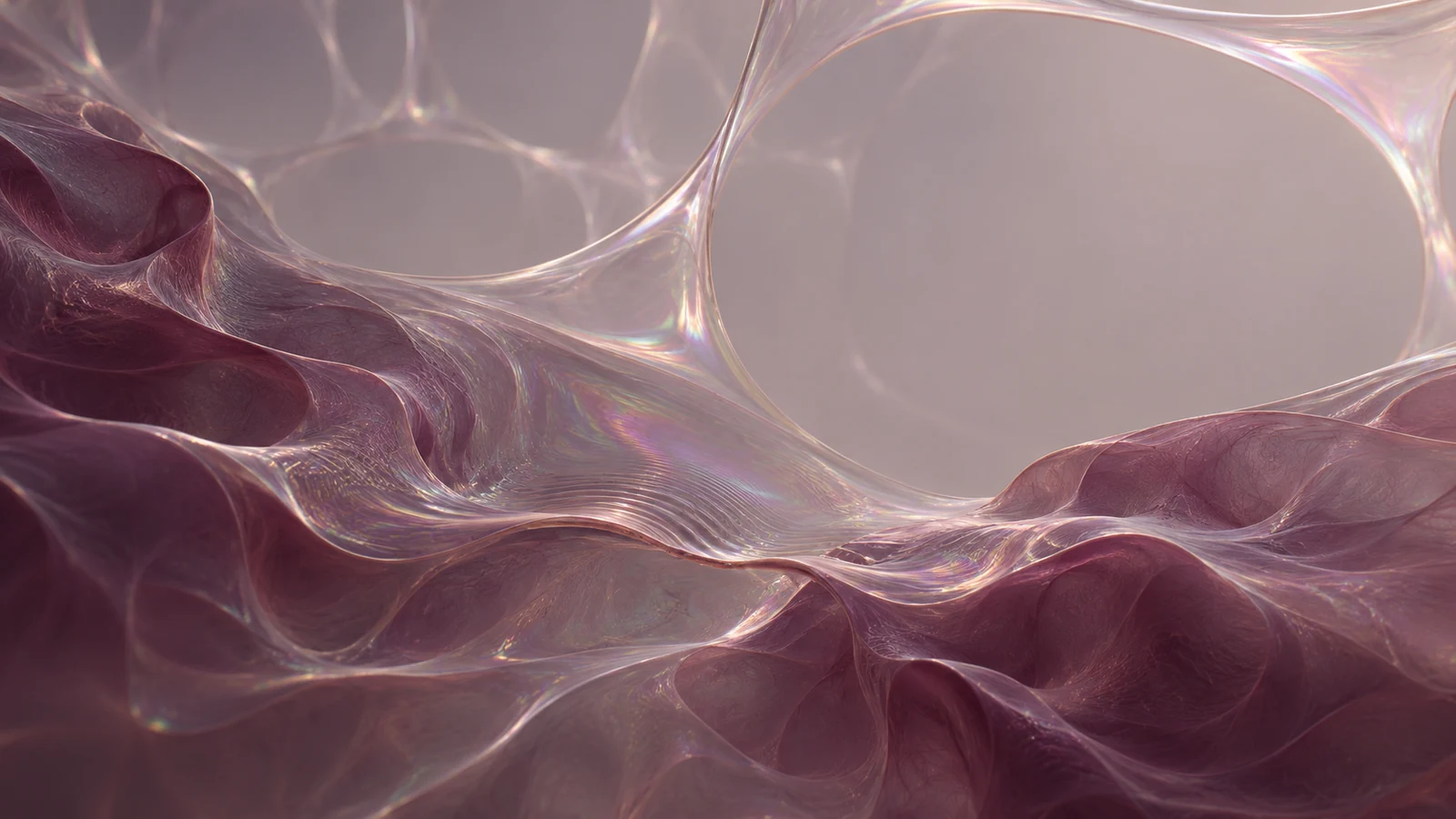
An image for the question of perceptual limits. Life in Foam is shown exclusively on the membranes of its imagined world.
Clearly, Foam's physical laws are very different from ours. The quantum physics familiar to us involves many fields and particles, including the Higgs boson, other bosons and fermions. In this universe at the edge of imagination, a single field would have four stable states, with laws, excitations and limits of its own. The “matter” and structures of such a world would certainly be incompatible with ours, putting them beyond detection by our instruments. We probably could not even observe that world physically, let alone interact with it in any meaningful or safe way.
Perhaps universes of this kind are interpenetrating our own at this very moment. Perhaps a drama between two Foldlings is unfolding close by, strangely reminiscent of our own relationships, while neither they nor we are aware of one another. Could so-called “dark matter” and “dark energy,” which together make up around 95% of the cosmos's total matter and energy and are known to us largely through their gravitational effects, consist of some alien matter and energy with laws of their own? Could their structure be rich enough to give rise to conscious beings? Or could the “higher layers” of reality, described by some spiritual explorers as the astral, mental and spiritual worlds, actually be this unfamiliar “dark” matter and energy?
For now, we have no answers. The questions, however, are deeply intriguing.
4. Counterflow
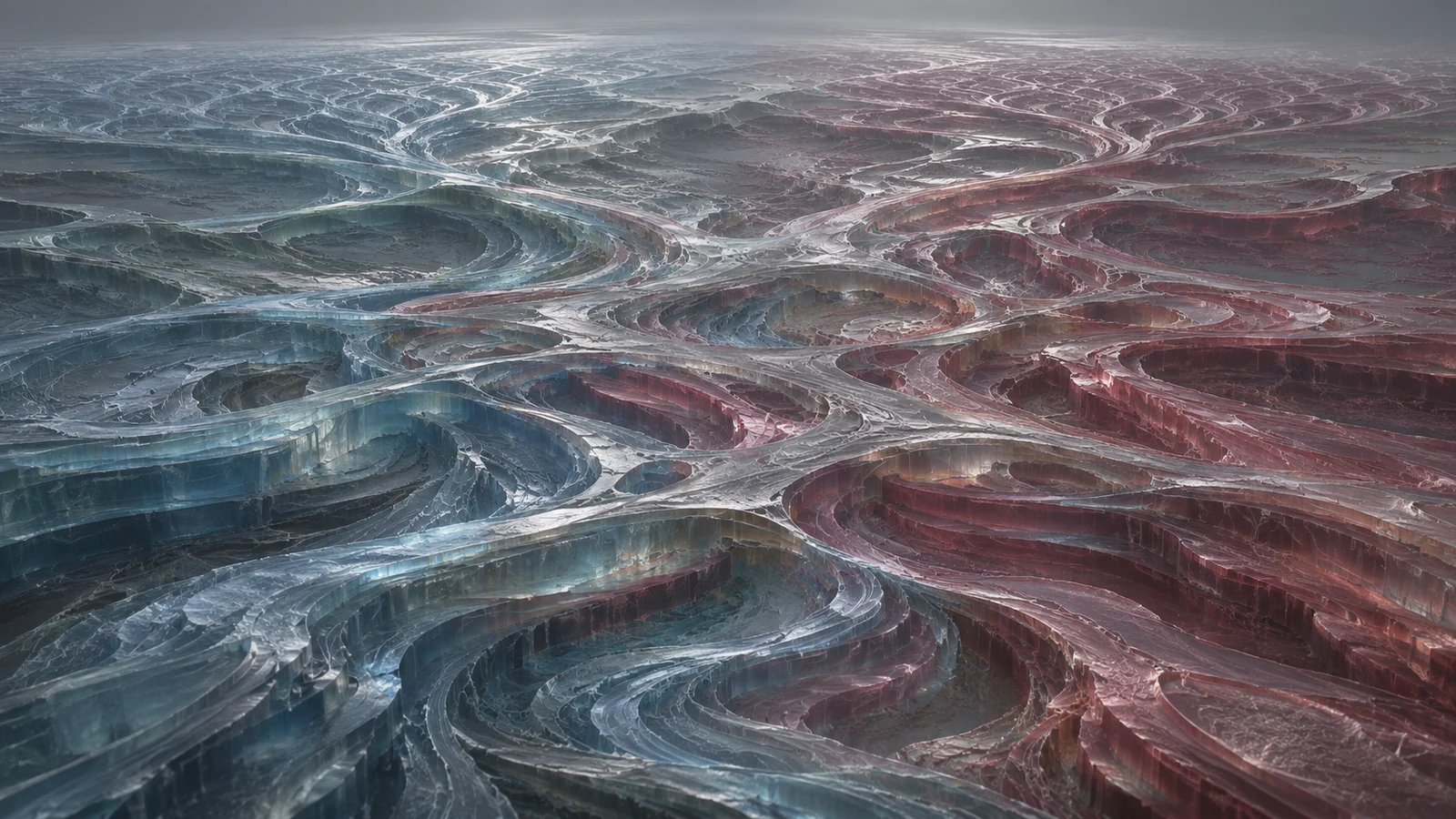
Counterflow at its largest scale. Interwoven channels represent encounters between two temporal orientations within one history.
Ner entered the channel and immediately felt a dull, steady pressure, like the sensation of diving deeper than we intended. That is roughly how his body feels the proximity of the opposite flow. His partner waited at the other end. The partner's identifying signal arrived first. In it, Ner read something that baffled him every time. His partner already carried a trace of the end of their encounter. For him, their parting was a memory, while their greeting was still to come.
Ner sent him a question, together with the range of answers he could receive. The first pattern to return was narrow and precise. The pressure rose sharply. Ner realized too late how difficult so much strain would be for his memory system to bear. One of his records shifted. He knew it contained two events. Yet he could no longer tell which had come first.
He broke off the exchange and waited for the pressure to subside. Then he proposed a different, broader agreement. It allowed more outcomes that fitted both accounts, so it required less force. The question went through. The answer arrived gently, with almost no resistance. Ner stored it together with a note about the route it had taken. They said their goodbyes, each in his own way.
On his way out, he settled the account. Of the six units of work he had set aside for the encounter, two remained. He took the shifted record with him just as it was.
One history, two memories
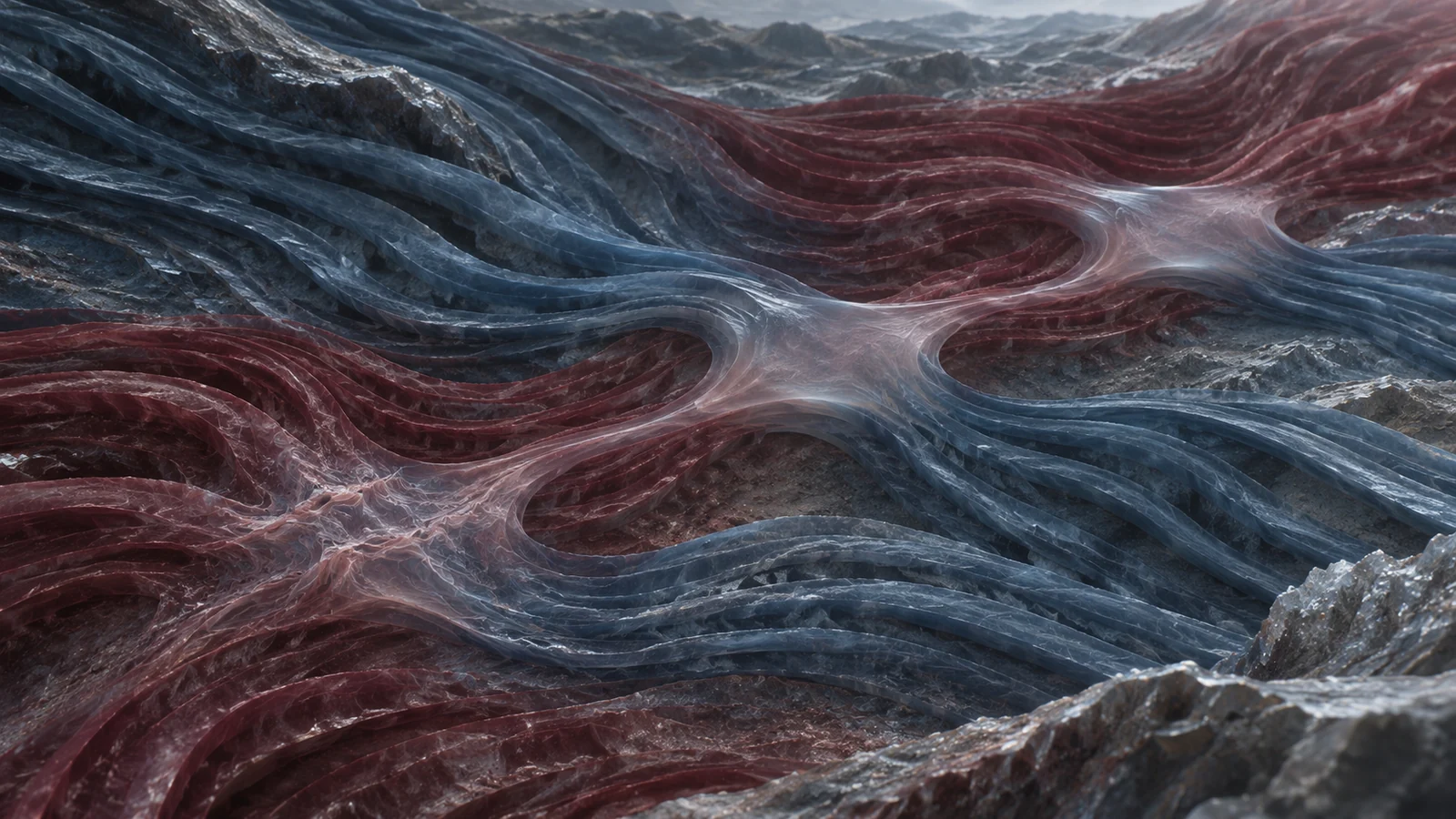
A shared setting for an encounter. Two ordered paths connect the same contact regions from different directions.
Let us consider what happened here. In the universe we have called Counterflow, there is a single history of the world. It must satisfy conditions specified at both of its temporal ends. Within it run two oppositely directed flows. Each inhabitant remembers in their own direction, so what one calls the past still lies ahead for the other.
As long as the two flows remain apart, each lives peacefully in its own temporal sequence of events. The difficulty often arises when they meet. An exchange between two beings must fit the memories of both parties at once. In our small model, we represent the cost of disagreement as physical strain, the very pressure Ner felt.
The model works like this. Each encounter has an expected outcome and a strain indicator, which we call e. When an encounter goes smoothly, e is zero. When extra adjustment is needed, e is one, the outcome changes and the “bill” rises. The law of this world then selects, from all possible histories, the one with the lowest total “cost.” If two are equally “expensive,” a predetermined ordering decides between them. There is no additional time in which history tries out solutions. Only the cheapest history is realized, whole and all at once.
These creatures set aside the work in advance. For three encounters, for example, they prepare six units: the base expenditure is three, and strain can consume at most another three. Ner's account now becomes clear. He had three exchanges: the first question, the repeated question and the parting. He paid three units for the exchanges themselves and one for the strain of the first.
Every case in one small family of these circuits has been counted. Of sixty-four, sixty have a cheapest history with no strain at all. In the remaining four, strain is unavoidable. An encounter between opposite flows can therefore usually pass peacefully. Sometimes, though, the world simply has no painless outcome to offer.
It is interesting to imagine the same encounter from the other side. The partner experienced the parting first. Then he received a gentle, open question and answered it. Only afterward came the moment of sharp pressure, and finally Ner's arrival. Both descriptions concern the same events, and both accounts balance. Only the order of the traces in the two memories differs.
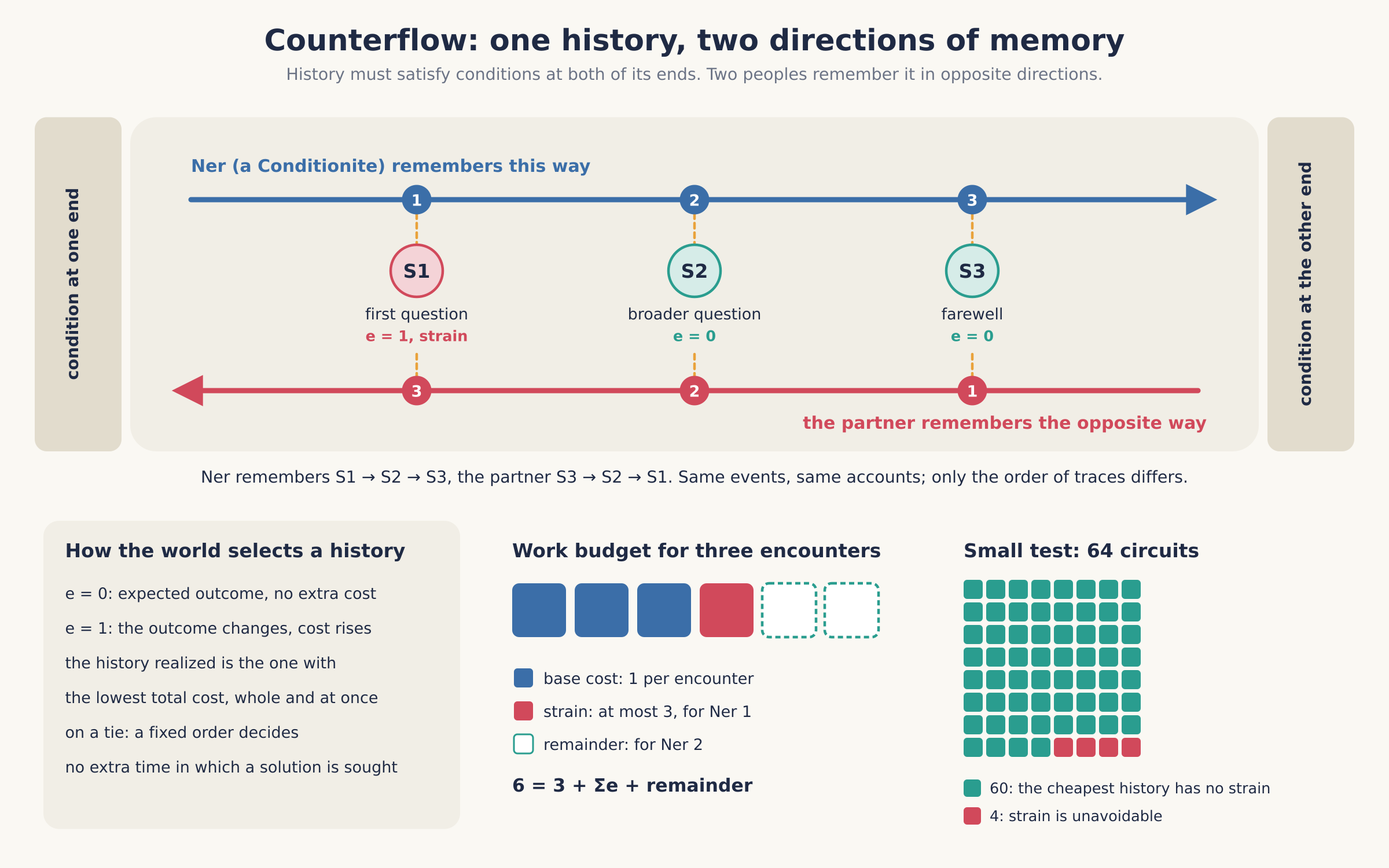
A schematic of the world’s rules. The supplied author’s diagram is reproduced unchanged.
Junction and its inhabitants
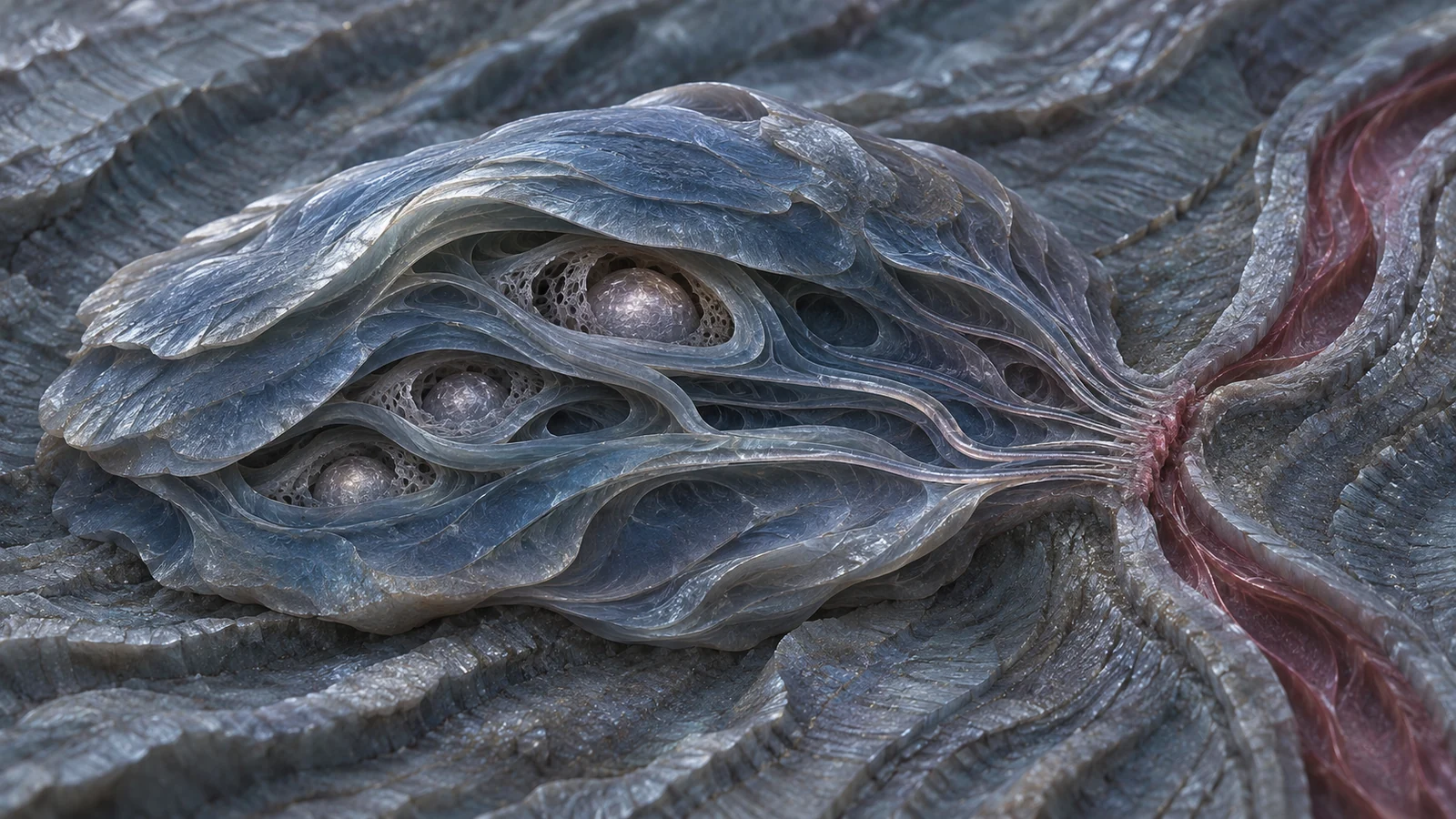
Ner, a Conditionite in Junction. His connected memory structures are shown beside a limited exchange zone.
We call the largest whole the Double Delta. Let us say it is a distant counterpart of a galaxy. Many channels run through it, and individual channels belong to different directions of time. We call the sources of work Conditioners. Their order is specified at the boundaries of history, at both ends.
Ner lives in a region called Junction. Local life there is reliable, and contact with the opposite flow is confined to special zones. We call the people of this region Conditionites. Each Conditionite belongs to one flow and cares above all about preserving its sequence, because that sequence is its autobiography. Any stronger disturbance can scatter it. The being then ceases to live, even though its fabric remains. Its offspring therefore receives a separate working process and reserves aligned with its own direction. Much of the technology these beings have developed serves one purpose: keeping strain away from the systems that remember.
I think such a world would develop a very unusual form of trust. Let us put ourselves in one of these creatures' places. A partner from the opposite flow possesses a trace whose origin lies in our future. To trust it, we must know the route by which it arrived. Every important claim would therefore be accompanied by the grounds for its reliability. Contracts would contain the same wisdom Ner learned the hard way: an overly precise plan demands great strain at the slightest change in circumstances, while a good agreement leaves room for several compatible outcomes.
Every important claim would therefore be accompanied by the grounds for its reliability.
Again, we can ask how much this strange world resembles ours. Time travel? Precognition? At least at their root, its existential questions sound familiar. How do we live and survive? How do we build the best relationships? How do we become wise? The natural laws in this universe are clearly very different from ours, yet some parallels with our existence remain.
5. Transmutation
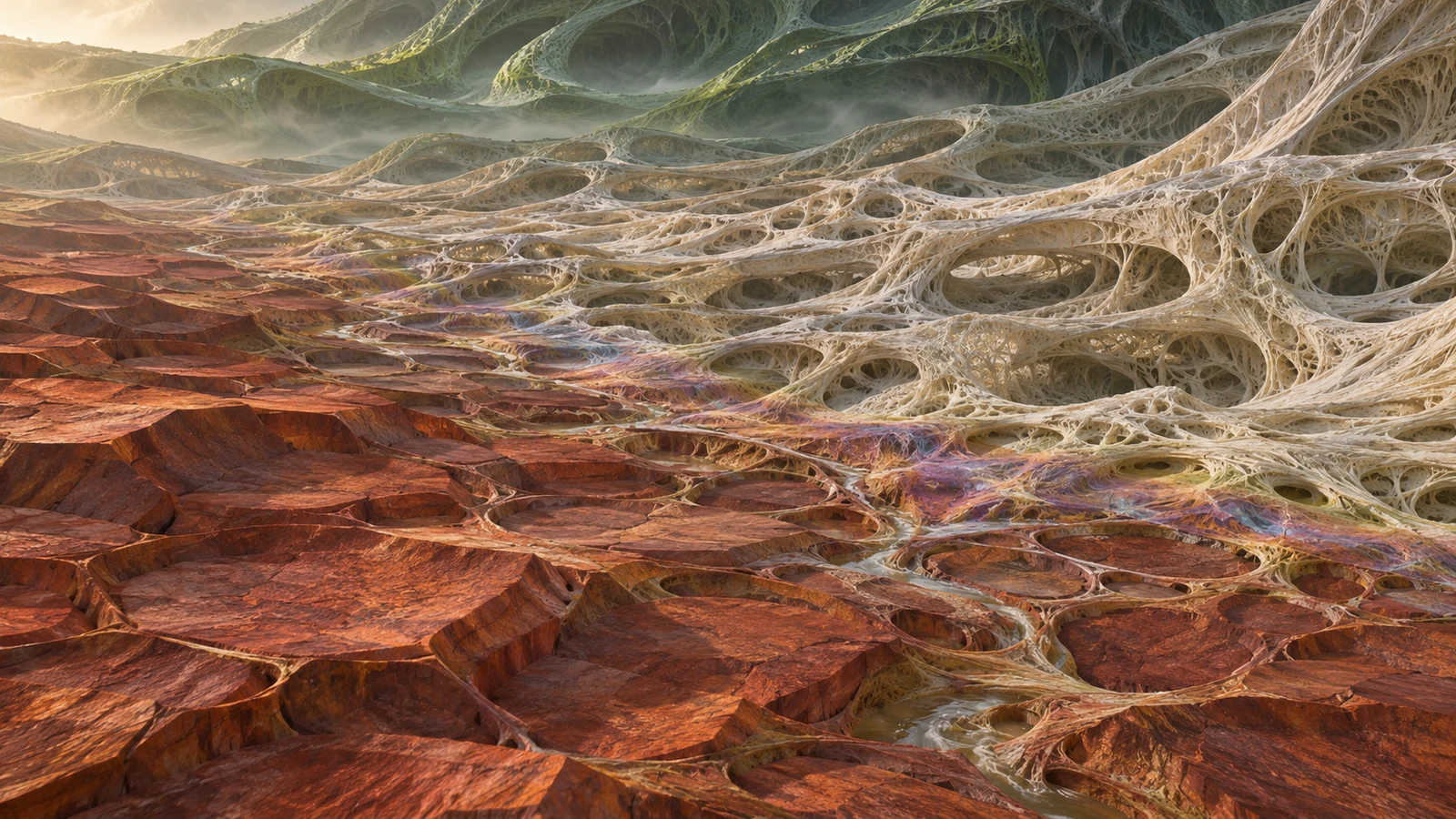
Transmutation at its largest scale. Connected paths cross regions of different physical constitution and a gradual regime boundary.
Some scientists think that distant parts of our universe might have slightly different laws. Certain theories allow this, although no observation has reliably confirmed it so far. Such differences would appear as small changes in physical constants, such as the fine-structure constant, the gravitational constant or the speed of light. Some measurements of light from distant quasars have suggested a tiny change in the fine-structure constant, but those results are disputed and remain unconfirmed. Even if such differences exist, present-day science is fairly confident that they are small. The same applies to possible changes in the laws over the billions of years of the cosmos's existence.
Let us now consider a universe in which physical laws differ from place to place and from time to time.
Imagine waking one morning to find that your arm responds in a new way. A movement that took one beat yesterday now takes two. Things around you are still in the same places, but the rules governing their motion have changed.
This is exactly what happens in Transmutation, according to a strict order. Change spreads through the world as a front, so an inhabitant can see it coming. By the time it arrives, the internal connections of the inhabitant's body must already be adapted.
We should also remember that the varied laws of this imagined world are very different from ours. Familiar structures such as galaxies, stars, planets, atoms and elementary particles can therefore give us little guidance. The physics there is entirely alien to us, and it varies from region to region as well.
A law governing laws
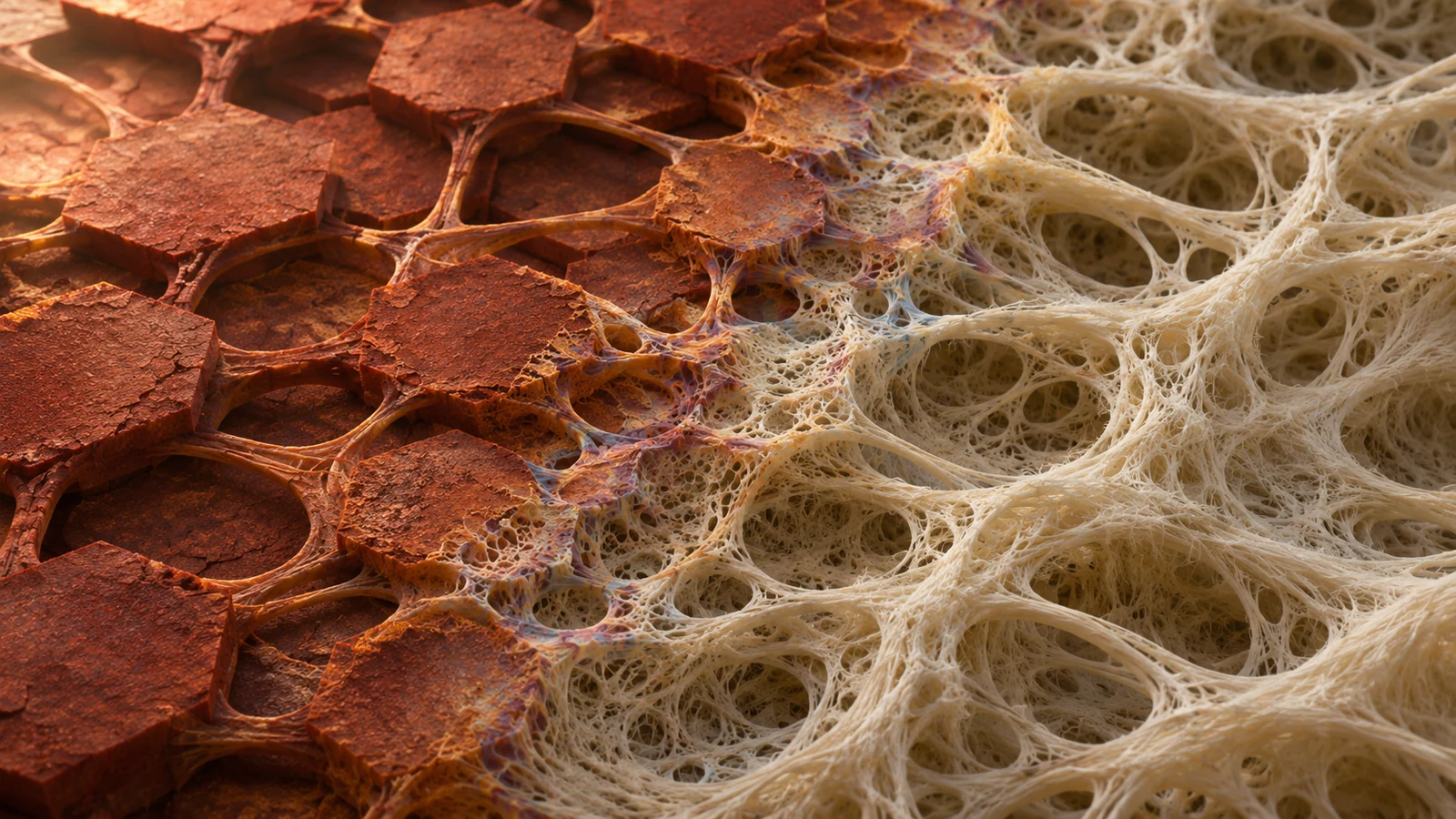
A regime boundary crosses an existing neighborhood. Transmission paths remain local and connected.
In Transmutation, every region carries two labels. The first is its local state, denoted by x. The second is a regime register r, which says which regime currently applies there. The regime determines the rule by which the region evolves. Above all the regimes stands one fixed rule, a meta-law, specifying when regimes change and which translations between them are allowed. We had to introduce the meta-law into our thought experiment because, without it, chaos would prevail and probably prevent any life from arising in such a universe.
Transmutation's meta-law requires boundaries between regimes to advance at a limited speed through neighboring regions. Change therefore reaches each region gradually. I think this is the world's most important concession to its inhabitants. Those living near a boundary have time to prepare, if they know how to read the signs.
Every preparation, of course, has a cost. In this imagined universe, we track three quantities for each region. The reserve W is what can still be spent on work. The spent portion D is what has already been used. The potential V is the value the organization, taken as a whole, has by virtue of its form in a given regime. The sum of these three quantities always stays the same. A change of regime can alter the potential of the same organization. That difference enters the work account, together with the cost of translation itself.
Consider a region that goes through four regime changes and returns to its original regime and state. At the start, the reserve is twenty, the potential five and the spent portion zero. Each change costs one unit. At the end, the reserve is sixteen, the potential is five again and the spent portion is four. The total is still twenty-five. The loop has closed, and its cost remains permanently recorded in the spent portion. The total loss of available work equals the sum of the costs of all the transitions.
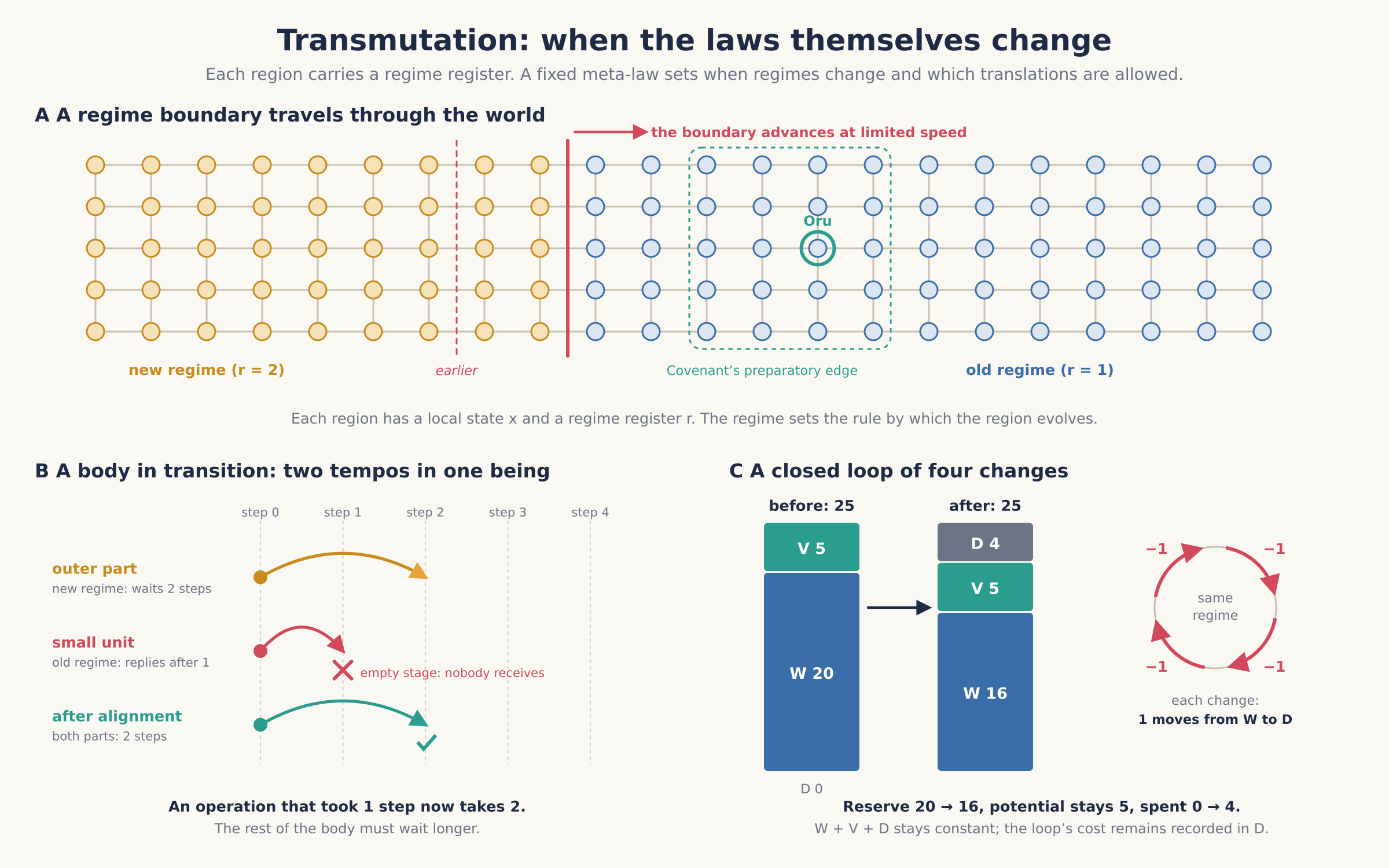
A schematic of the world’s rules. The supplied author’s diagram is reproduced unchanged.
The Archipelago of Laws
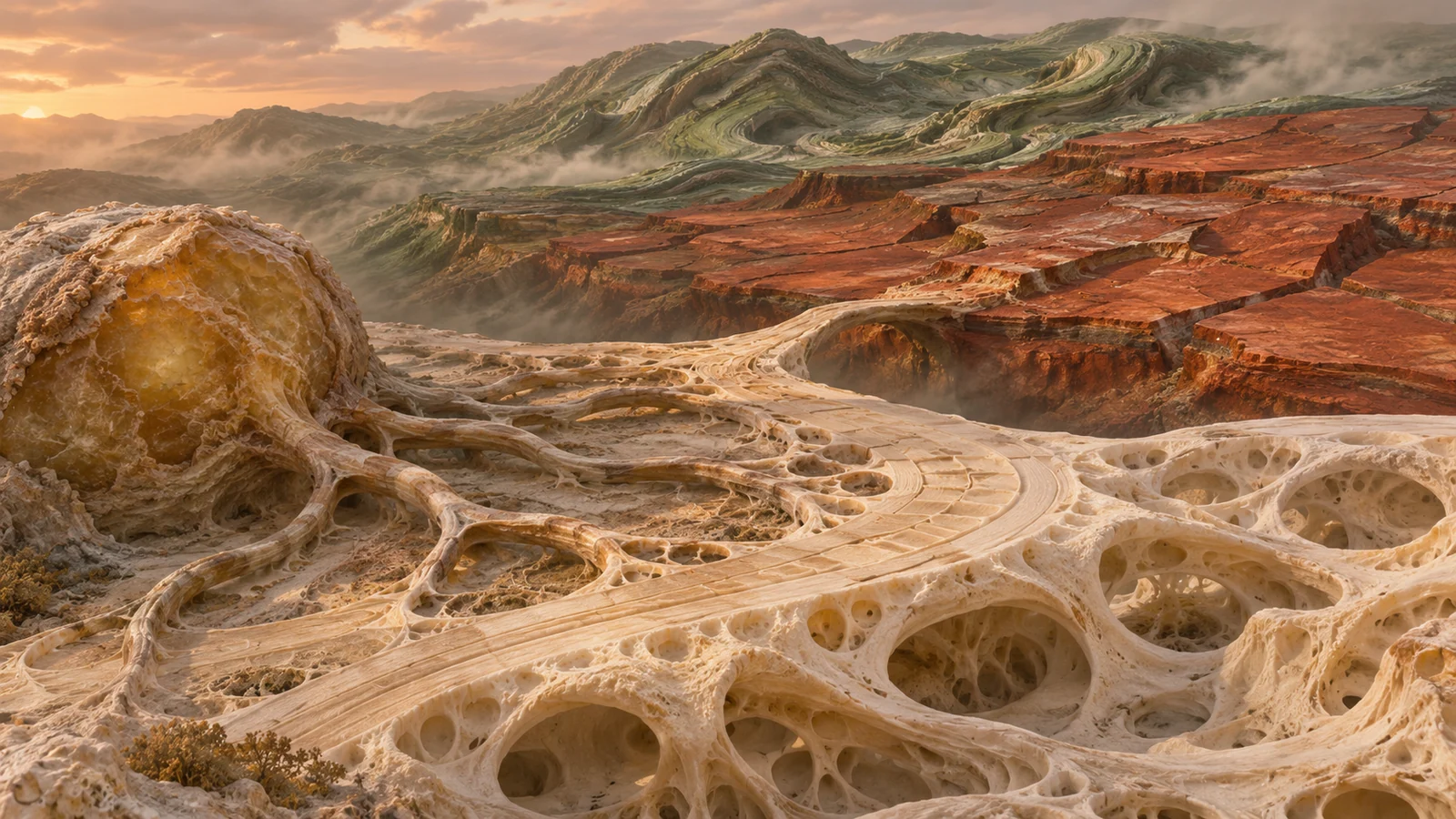
Covenant and its preparatory edge. Broader regions of the Archipelago are linked by limited passages and work sources.
We call the largest whole the Archipelago of Laws. It consists of large regions with different regimes, like islands with their own rules. For an inhabitant, the crucial question is which route allows its body to pass into a neighboring region. Some boundaries permit a viable continuation, with the appropriate preparation, of course. That preparation is supported by the Spiller, a source of work with a finite initial reserve that is itself gradually consumed.
Our habitat is called Covenant. It is a stable region with a preparatory edge, where inhabitants watch for approaching change and prepare their translations in advance. The value of such a habitat is measured first by the length of its warning. It is also measured by how many processes have a viable realization in the neighboring regime.
The Translator
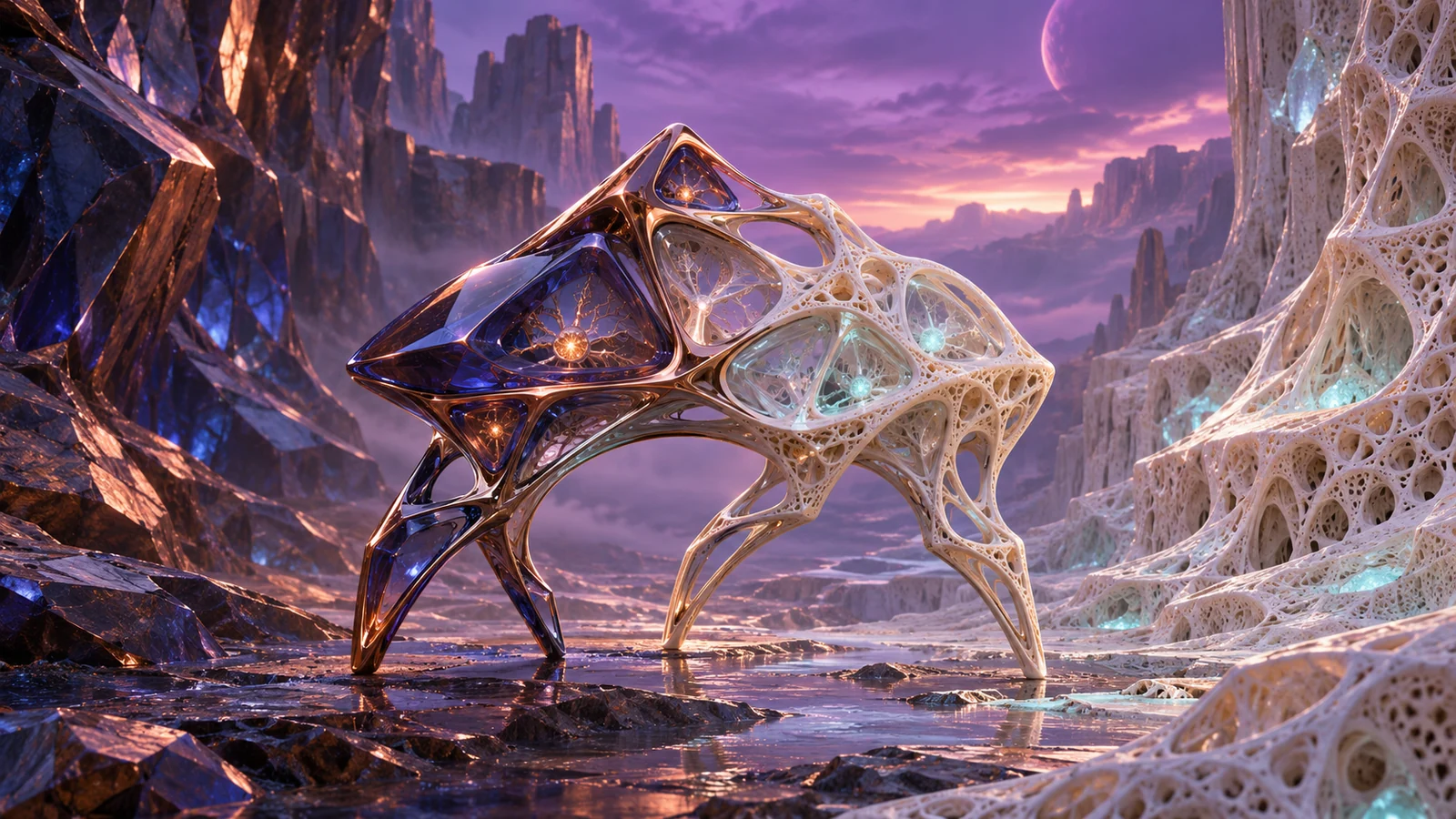
Oru, a Translator. His connected bodily structure undergoes a change of physical regime.
Like many other universes, this one has numerous inhabitants and many kinds of creatures that differ greatly from one another. Their circumstances, however, give almost all of them certain traits in common.
We will take one inhabitant of Transmutation as our example and call it a Translator. It survives by transferring, or translating, the relationships of its body into a different physical fabric when the time comes. With each memory it must also preserve a way of reading it. It is vital to connect records from the old regime to parts that can use them in the new one. Translation therefore covers the whole route, from the preserved trace to the next action.
This being senses the approach of a boundary through control operations, small familiar actions it repeats continually. While all is well and the boundary is far away, each response arrives on its proper beat. As the boundary approaches, the response begins to lag or change shape. The Translator then compares the trace it receives with its stored model and, naturally, prepares the appropriate translation.
The hardest part is coordination. Take a simple example. A bodily response used to require one step; in the new regime, it will need two. The other parts of the body must therefore wait longer. Otherwise, an arriving response would reach its recipient at the wrong stage of the task. During a transition, different parts of the same body temporarily operate under different rules. The body survives by keeping them in agreement. A Translator's body must be able to carry out the same operation even in a regime where it takes twice as long.
*
Oru received a warning from the preparatory edge. The boundary was coming faster than the maps had predicted, and his account showed that he lacked the reserve for the final stage of translation. He sent a request to the communal fund and waited.
The supplement arrived, but it was smaller than he had requested.
He began with the outer systems. Their responses now required two steps each, and they adapted quickly. In the parts still operating under the old regime, he slowed reception one by one. He missed one. It was a small system deep beside the memory core. It rarely spoke, and Oru had mistakenly left it off the list.
An outer part sent a message and expected an answer after two steps. The small system answered after one, into an empty stage where nobody received it. The outer part concluded that the connection was failing and sent the message again. The same thing happened. Oru felt his own interior as two voices endlessly missing each other, each keeping its own beat.
Fortunately, he found the omission and managed to slow that system too. Each repeated attempt consumed work, leaving exactly enough for the memory core, without the small reserve he had wanted to save for the end. He translated the core last. Then he accessed the record of the procedure's beginning. The same relationship returned in a different rhythm, slower and a little blurred at the edges. The boundary passed over him. With an empty reserve, Oru continued through a region that now had different rules. He was satisfied all the same.
*
Is it the same life
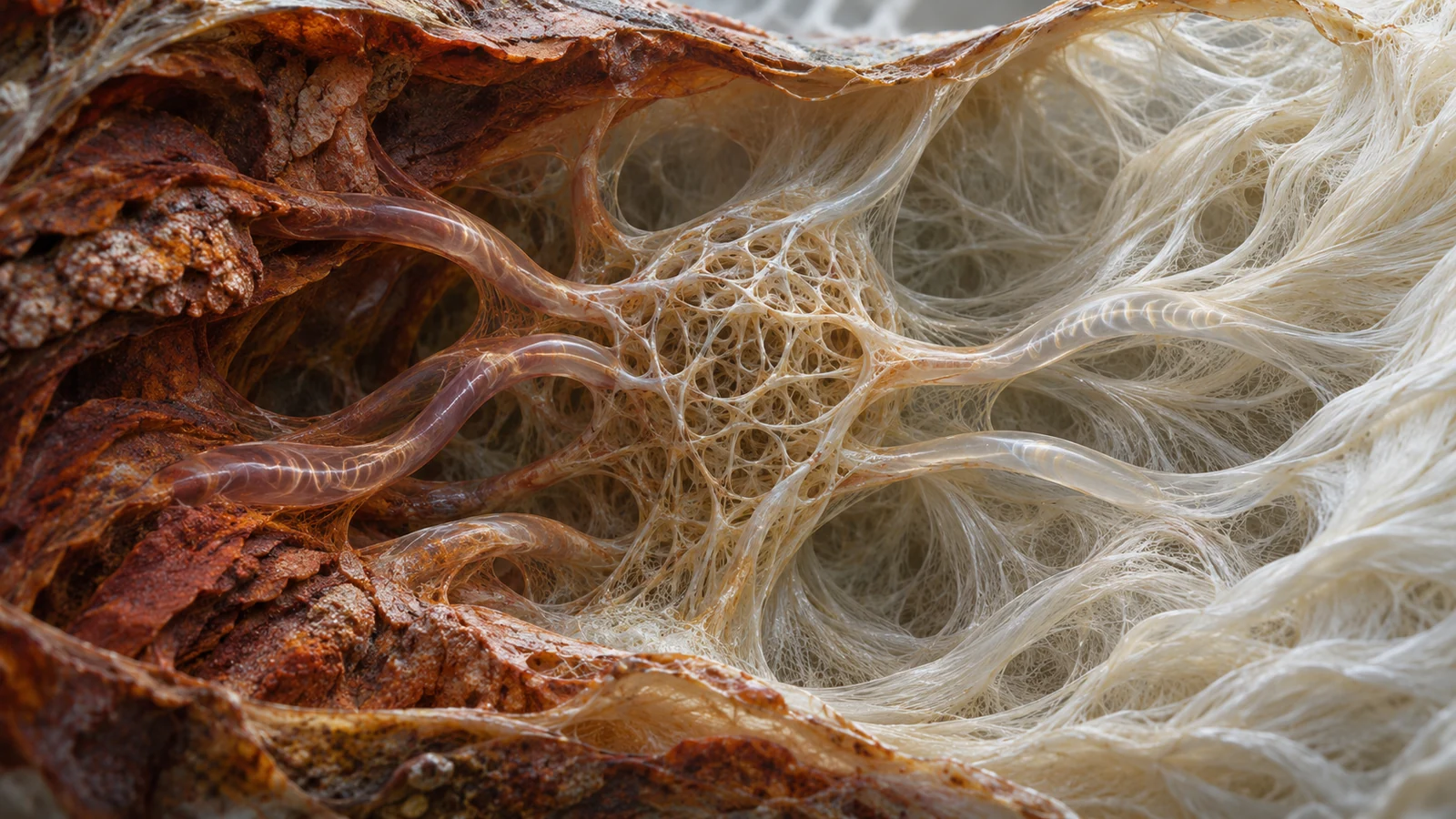
A reorganized body retains access to earlier records. Physical continuity and personal experience remain distinct questions.
Consider how Translators reproduce. An offspring receives an initial organization and part of the repertoire of translations. This repertoire is an inheritance in the fullest sense. An unfamiliar regime may present an obstacle for which no available translation preserves the necessary relationships. At that point, the body's ability to continue ends. Sooner or later, this happens to every Translator.
One question remains, posed by this world more sharply than by any of the others. Is a being still the same being after a successful translation? The answer is unclear and difficult to test. We can only speculate about what that continuation of existence feels like from within.
Transmutation's civilization would maintain special preparatory regions, and the right of access to translation could determine who survives a boundary's arrival. Every message in its language would carry the label of the regime in which it makes sense. Maps would show how much time each inhabitant had left before the boundary arrived. It seems to me that such a culture would value a carefully prepared transition as a special life skill, perhaps the highest of all.
Is change desirable?
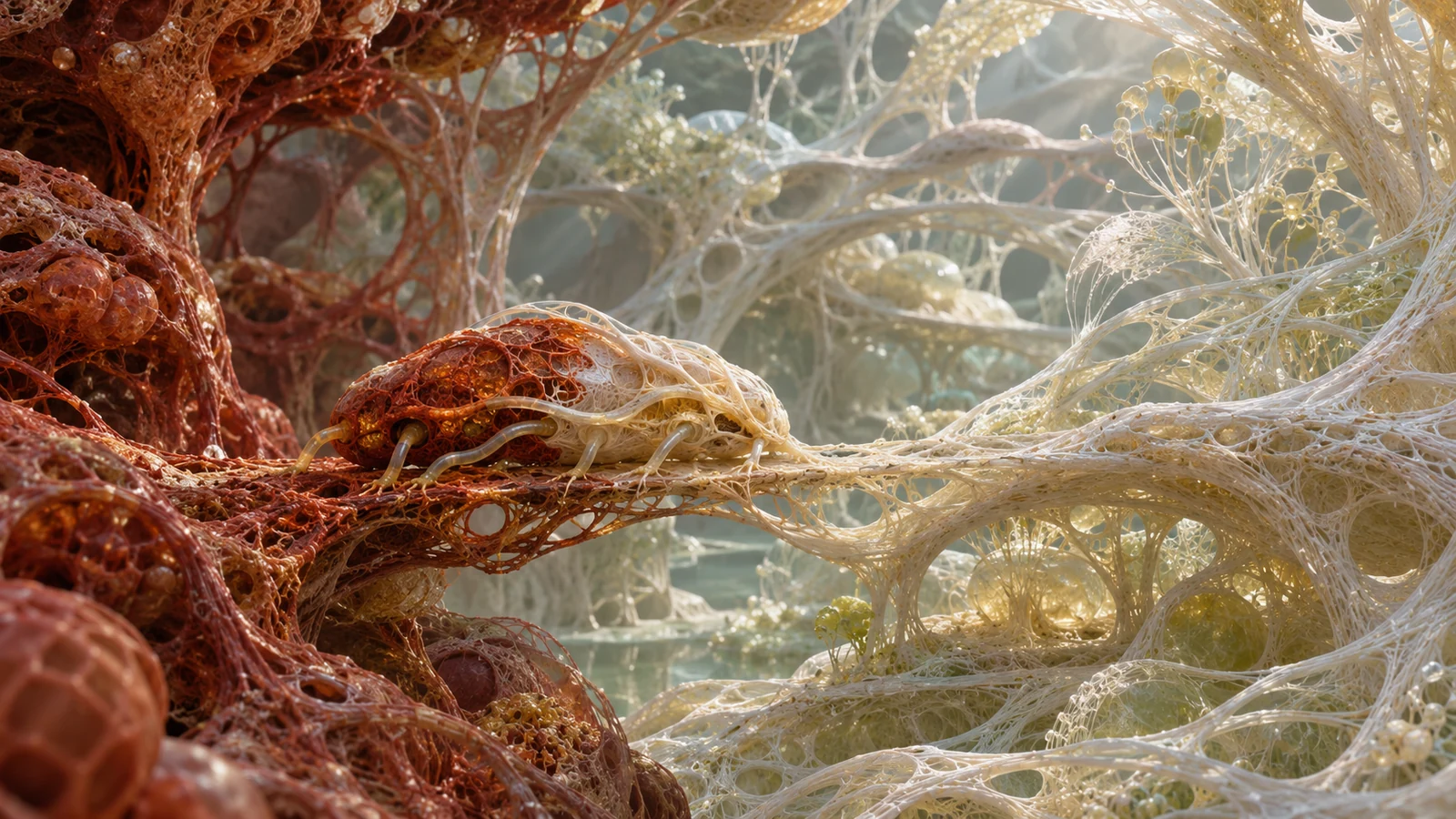
A prepared passage leads into a different region. Adaptation depends on physical organization and remaining work reserves.
We might draw one conclusion: let us be grateful that we live in a world with fixed laws, where everything is fairly predictable, at least on the macroscopic scale. But is that the whole story? Translation resembles many changes in our own world, major challenges and even suffering. Yet change pushes a person out of their comfort zone, and that is precisely what leads to growth and maturity. We can therefore reach another conclusion: life in Transmutation could give rise to beings of exceptional abilities and accomplishments.
I have also written about how harsh conditions can become a demanding school, and about questioning their interpretation as punishment, in Earth: Prison Planet or School of Life?.
What we take away from five worlds
Let us return to an ordinary encounter. Someone speaks to us; we listen and answer. That brief exchange depends on many conditions we rarely notice. First, there must be a channel reliable enough to carry the message. Second, both of us must last long enough to finish the conversation. And third, we must have some way of retaining a trace of what was said.
The five worlds took those conditions apart. Sela showed us that understanding requires knowing another being's rhythm. Ilan discovered how difficult it is to know that a home is truly enclosed when space has a direction we cannot see. Savaj reminded us that a memory lives on a surface that can change. Ner paid the price of excessive precision with someone who remembers time in reverse order. Oru, moreover, had to translate himself, spending his last reserve on his own past.
After each of them, the same question remains: under what condition do we call a continuation the same life?
A Layerling is a community and, at the same time, part of a larger community.
A Tetran is a whole that nobody outside can see all at once.
A Foldling moves its own past from place to place.
A Conditionite is a sequence that one intense encounter can rearrange.
A Translator, finally, is a relationship that persists through a change in the very fabric of its body.
I think these examples help us see more clearly how much we assume when we say “I.”2
Can we imagine something truly different?
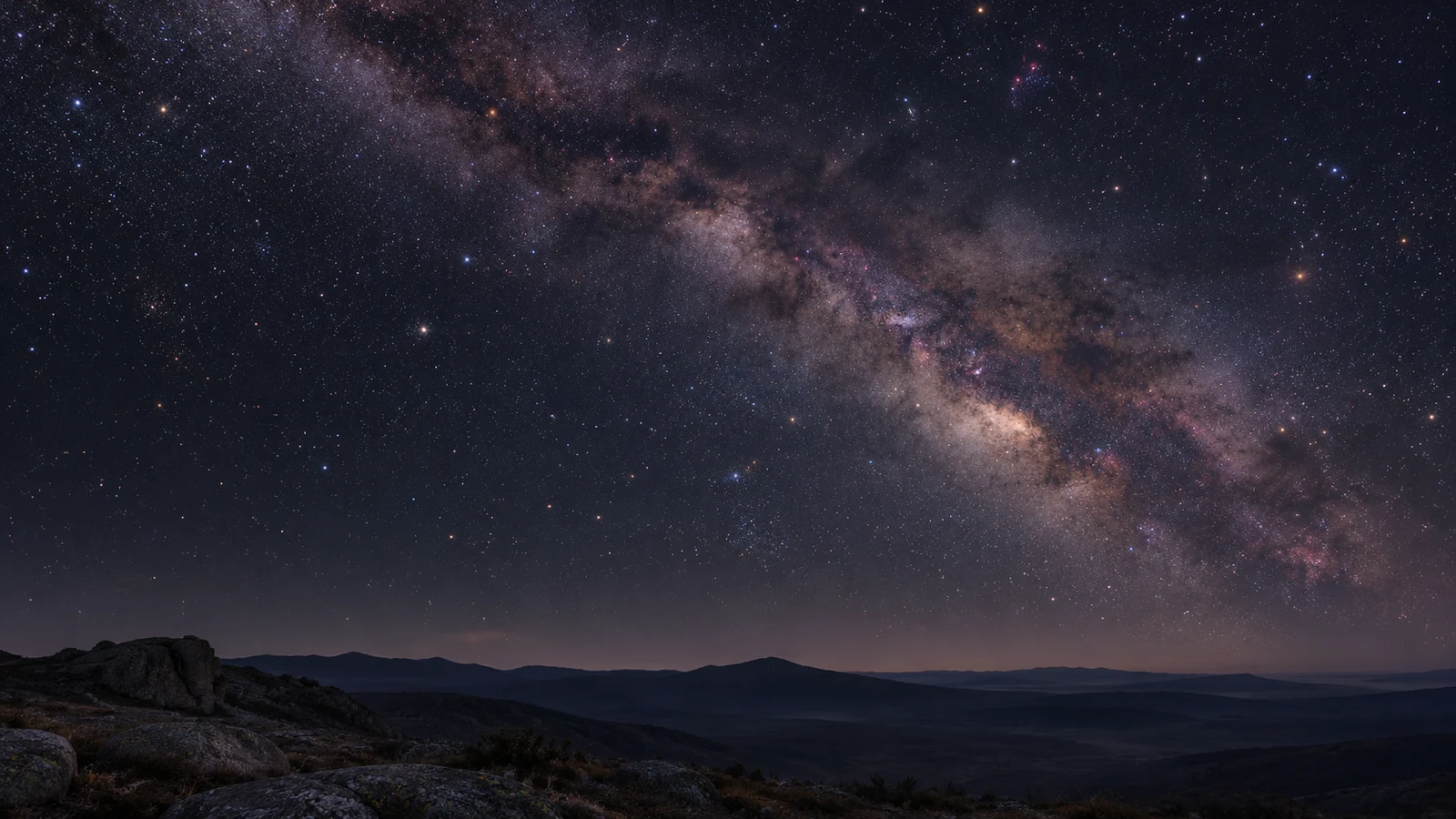
A view of the night sky returns us to the limits of imagination. The familiar cosmos remains the starting point for this comparison.
In each of these worlds, although we tried to make it completely different from our own, we spontaneously found some shared trait. The Scaleless World reminded us of fractals and the hierarchies of our society. Foam led us to think about dark matter and higher layers of reality. In Counterflow we recognized old questions about living wisely. Transmutation brought us back to the changes that force us to grow. It seems we can find parallels everywhere.
Is this simply because our minds are too limited to conceive of something truly different? If we did conceive of something wholly unlike anything we know, could we imagine it at all, or, worse still, describe it?
Just think of the diversity in our own cosmos: so many different galaxies, stars and planets, to say nothing of the countless, utterly different beings that probably exist throughout it. All of this rests on physical laws that are the same here and ten billion light-years away. How much greater a diversity of structures, civilizations, individual beings and inner experiences might we expect on an imagined journey through entirely different universes?
It seems to me that the similarities we keep finding tell us something about both possibilities. Our minds certainly have their limits. Yet some patterns probably belong to every reality in which something endures, remembers and encounters another: finite sources, routes for messages, the cost of memory.
Indeed, the value of these thought experiments lies in changing the question itself. We can begin by looking at what a particular reality permits, then ask who might be able to endure there. That lets us move beyond our habit of looking for something human wherever we go.
Let us look at the night sky again. We have tried to broaden our idea of who might be looking at it and, in some cases, what looking itself might mean. Perhaps afterward we will listen even to a familiar companion with much more patience. We can ask what their response depends on, and what something that seems easy to us costs them.
Sources
The works listed here support the starting ideas. The inhabitants and their civilizations belong to the thought experiments.
D. Sornette, Discrete scale invariance and complex dimensions, 1998 (The Scaleless World). arXiv:cond-mat/9707012
V. Rubakov and M. Shaposhnikov, Do we live inside a domain wall?, 1983 (Foam). Physics Letters B
A. D. Gopal and D. J. Durian, Nonlinear Bubble Dynamics in a Slowly Driven Foam, 1995 (Foam). Physical Review Letters
M. R. Douglas, The statistics of string/M theory vacua, 2003 (introduction). arXiv:hep-th/0303194
Notes
1. By the holographic principle, I mean here the idea that every part of reality carries information about the whole, just as every fragment of a hologram contains the entire image. Inner and outer then reflect one another. In physics, the same term refers to a narrower idea: that information about a region of space can be recorded on its boundary. I have described my understanding of this principle on the page The Holographic Principle. ↩
2. The question of where experience belongs, to the whole or to its parts, is familiar to our own psychology as well. I have written about personality as a system of parts that cooperate or come into conflict on the page Parts of Personality. ↩
Selected illustrations on this page were generated with AI to reflect the themes discussed in the surrounding text.


Loading comments…
Add a comment
Comments are reviewed before publication. Your name or nickname, comment and date will be public after approval. No account is required. Privacy policy